Category: Buying Guides

  • Custom Luggage Tag Buying Guide: Prices, MOQs & Lead Times

    If you’re pricing out a custom luggage tag for a wedding welcome bag, a corporate gift box, or a fleet of matching suitcases for your family, the range of quotes you’ll get back can be dizzying — anywhere from $0.75 to $7 per tag depending on material, quantity, and how it’s personalized. That spread isn’t random. It comes down to a handful of variables: whether you’re printing on soft PVC or engraving leather, how many pieces you’re ordering, and how fast you need them.

    This guide walks through what a custom luggage tag actually costs at different order sizes, which materials hold up to baggage handlers and which ones crack in cold cargo holds, and how long production realistically takes once your artwork is approved. The numbers below come from current supplier pricing pages and listings, not averages pulled from thin air — so you can walk into a quote conversation already knowing what’s reasonable.

    How much does a custom luggage tag cost?

    Price is driven mostly by quantity and material, in that order. On the low end, standard PVC rubber luggage tags — the kind most promotional companies push for conference swag or trade show giveaways — run roughly $2.00 to $4.00 per piece when you order between 250 and 500 units, with the per-tag price continuing to drop at higher volumes. Some simpler 2D-printed styles dip as low as $0.75-$1.50 per unit in the right quantity tier.

    Leather and vegan-leather tags cost noticeably more because of the material and the extra step of attaching hardware like a steel loop or strap. A wholesale vegan leather tag with a laser-engraved logo runs from $6.99 each at a dozen pieces down to $4.59 each once you clear 500 units, and adding individual name personalization typically adds about $1 per tag on top of that. Leather tags with a steel loop can start around $2.50 each at the 100-piece mark when ordered through a promotional supplier rather than a boutique leather shop.

    The practical takeaway: if you’re ordering under 50 tags for a family or small group, expect to pay closer to the top of these ranges. If you’re outfitting a corporate gift program or a large wedding party, order at least 250-500 to unlock meaningfully lower per-unit pricing.

    Materials: what actually holds up in transit

    PVC (soft rubber) dominates the bulk custom luggage tag market because it’s flexible, waterproof, and cheap to mold in full color. Its main weakness is cold: PVC can go stiff and crack in extreme low temperatures, which matters if your tags are riding in an unpressurized cargo hold on a winter flight. It’s also the easiest material to produce in small, intricate logo shapes without a mold fee in many cases.

    Genuine and vegan leather tags read as more premium and are the default choice for corporate gifting and wedding favors, since they take embossing, debossing, and laser engraving well and the branding won’t wear off with handling. The tradeoff is that leather can warp or discolor under sustained moisture, so it’s a better fit for carry-on use or gift-only tags than for luggage that gets checked in the rain.

    Acrylic tags sit in between: they resist fading better than PVC under sun exposure and stay rigid without becoming brittle, making them a reasonable choice for a custom luggage tag that needs to look sharp for years rather than one trip. Metal tags (aluminum or stainless) are the most durable and the most expensive, typically reserved for premium retail products rather than bulk giveaways.

    Minimum order quantities and where the price breaks happen

    Most suppliers set a standard minimum order of 100 pieces for a custom luggage tag, though the per-unit price rarely gets attractive until you’re ordering between 250 and 1,000 units — that’s the range where the fixed costs of setup and artwork get spread thin enough to matter. A handful of suppliers offering leather or wood tags will accept MOQs as low as 25 pieces, which is useful if you’re testing a small batch before committing to a bulk run.

    If your order sits below 100 units — say, you just need tags for your own family’s luggage — expect to pay retail-style pricing per piece rather than a wholesale rate, and confirm with the supplier whether they’ll even accept an order that small before you request a formal quote.

    Per-tag cost for a custom vegan leather luggage tag falls from $6.99 to $4.59 as order size grows from a dozen units to 500+.12-24 units: $6.99; 25-99 units: $6.41; 100-199 units: $5.83; 200-499 units: $5.25; 500+ units: $4.5912-24 units$6.9925-99 units$6.41100-199 units$5.83200-499 units$5.25500+ units$4.59
    Per-tag cost for a custom vegan leather luggage tag falls from $6.99 to $4.59 as order size grows from a dozen units to 500+.Source: Lifetime Creations bulk custom luggage tags listing, Etsy (retrieved August 2026)

    Lead times: standard production versus rush

    Once artwork is approved, standard production on a custom luggage tag order typically takes 10 to 15 business days before it ships — that’s separate from proofing time and shipping transit, so build in extra buffer if you’re working toward a fixed event date like a wedding or conference. Some suppliers quote tighter windows around 5-10 business days, while others state 2-3 weeks as their baseline.

    Nearly every supplier offers a rush tier for an added fee. On the fast end, some can compress production to as little as 24 hours plus a few days of shipping. If your date is fixed, ask for the rush price at the same time as your standard quote — the markup is usually easier to swallow than a missed deadline.

    Standard production windows range from about a week to three weeks across suppliers; most also sell a rush option.
    Supplier Standard production time Rush option
    Monterey Company 2-3 weeks Not specified
    Bag Tags, Inc. 15 business days Not specified
    My Plastic Business Card ~10 business days Not specified
    Arnett Credentials 5-10 business days Not specified
    GS-JJ 10-15 business days As fast as 1-day production + 3-day shipping
    Standard production windows range from about a week to three weeks across suppliers; most also sell a rush option.Source: Supplier production-time pages: Monterey Company, Bag Tags Inc., My Plastic Business Card, Arnett Credentials, GS-JJ (retrieved August 2026)

    Personalization methods and sizing

    How the logo or name gets onto the tag affects both price and how long it lasts. Screen printing and full-color digital printing are the cheapest options and work well on PVC and acrylic, but flat-printed ink can wear thin after years of baggage handling. Laser engraving and debossing cost more per unit but etch or press the design into the material itself, so it won’t rub off — this is the standard method for leather and metal custom luggage tags used as long-term corporate gifts.

    On sizing, there’s no single mandated standard, but the market has settled around a few common shapes. The most typical custom luggage tag measures about 2.5 x 4 inches (65 x 105mm), giving enough room for a name, phone number, and small logo without becoming unwieldy on a shoulder strap. Larger formats — up to roughly 5 x 10 inches — show up on duffel bags and oversized cases, but anything much bigger than 3 x 6 inches starts to feel disproportionate on standard carry-on luggage.

    When you’re comparing quotes, ask specifically whether the price includes a privacy flap (a small cover over your address info), a strap or clasp, and double-sided printing — these are common places where a quote that looks cheap on the surface adds cost once you specify the full design.

    Frequently asked questions

    What's the cheapest material for a bulk custom luggage tag order?

    Soft PVC (rubber) tags are typically the least expensive option in bulk, running roughly $2.00-$4.00 per piece at 250-500 units, with some simple 2D-printed styles going lower. They’re flexible and waterproof, though they can stiffen or crack in very cold cargo holds.

    How many custom luggage tags do I need to order to get a good price?

    Most suppliers set a 100-piece minimum, but the price-per-unit doesn’t drop meaningfully until you order between 250 and 1,000 pieces. If you only need a handful, expect near-retail pricing per tag rather than a wholesale rate.

    How long does it take to get custom luggage tags made?

    Standard production generally runs 10-15 business days after you approve the artwork proof, not counting shipping time. Most suppliers also offer a rush option, with some able to produce in as little as 24 hours for an added fee.

    Is leather or PVC better for a custom luggage tag?

    It depends on use. PVC is cheaper, waterproof, and ideal for bulk giveaways or checked luggage, but can crack in extreme cold. Leather looks more premium and takes engraving well, making it a better fit for corporate gifts or carry-on use, but it can warp with sustained moisture exposure.

    What size should a custom luggage tag be?

    There’s no mandated standard, but about 2.5 x 4 inches is the most common size, offering enough space for a name and contact info without being bulky. Larger tags up to roughly 5 x 10 inches are available for duffel bags and oversized luggage.

    The bottom line

    The right custom luggage tag order comes down to matching material and quantity to how the tags will actually be used. For a one-time corporate giveaway or event favor in the hundreds, PVC at $2-$4 a piece is hard to beat on cost. For a smaller batch of gifts meant to last — a wedding party, a client list, a family set — leather or acrylic in the 25-to-100 range will cost more per unit but hold up and look better for years.

    Whichever direction you go, request quotes at two or three quantity tiers before you commit, confirm the standard production window against your actual deadline, and ask upfront about rush pricing if there’s any chance your date is tight. That’s usually enough to avoid both overpaying and getting caught short on time.
  • Custom Luggage Tags: Materials, Sizing & Branding Guide

    Custom Luggage Tags: Materials, Sizing & Branding Guide

    Custom Luggage Tags: A Materials, Sizing, and Branding Guide

    Getting custom luggage tags right comes down to three decisions: the material, the size or spec, and how you brand them. Make those well and you end up with custom luggage tags that protect and present your product, reinforce your brand, and land on budget. This guide walks through the material options, how to size and spec your order, and how to decorate custom luggage tags so they do real work for your brand rather than just checking a box.

    Whether you are ordering your first run or reordering at scale, the same fundamentals apply. Choosing custom luggage tags deliberately — material to job, size to product, decoration to brand — is what separates an order you are proud of from one you settle for.

    Why custom luggage tags matter for your brand

    Custom luggage tags are more than a commodity; they are a touchpoint brands experience directly. A well-chosen, well-branded option signals quality and attention to detail, while a generic one quietly undercuts an otherwise strong product. Because custom luggage tags are seen and handled, they carry your brand into the world every time they are used.

    That visibility is exactly why it pays to spec custom luggage tags intentionally. The material sets the feel, the size sets the fit and cost, and the decoration sets the impression — and getting all three aligned turns a functional item into a genuine brand asset.

    Materials and options compared

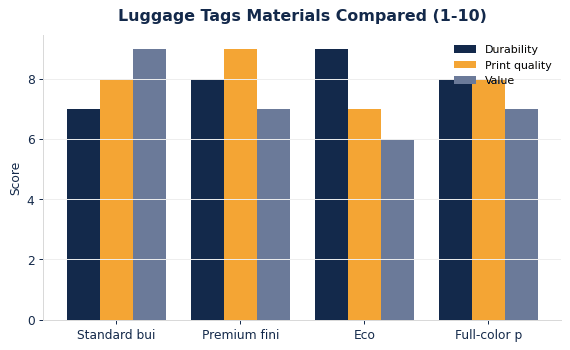
    The common materials for custom luggage tags each trade off durability, print quality, and cost: standard build, premium finish, eco / recycled, and full-color print surface. The right pick depends on how the luggage tags will be used, the look you want, and your budget. The chart and table below compare the main options so you can match material to job.

    How common luggage tags materials compare on durability, print quality, and value.
    How common luggage tags materials compare on durability, print quality, and value.

    As a rule of thumb, choose a recyclable or natural material when eco positioning matters, a coated or laminated option when you want vivid full-color print, and a premium build when the luggage tags is part of a gift or high-end presentation. When in doubt, request a sample so you can judge feel and print before committing to a full run.

    Material / option Best for
    Standard build reliable, cost-effective for high-volume swag
    Premium finish soft-touch or upgraded feel for gifting
    Eco / recycled sustainable option that signals brand values
    Full-color print surface vivid, edge-to-edge branding area

    Sizing and specs

    Sizing is where many luggage tags orders go wrong, so measure before you order. Custom luggage tags typically range from a compact giveaway up to a larger statement piece, and the right size and format depends on the product or use they serve. Too small and the fit is tight or the product is exposed; too large and you pay for material you do not need and lose a clean, intentional look.

    When a measurement falls between standard options, size to the product with a small margin rather than guessing. Confirming the size and format on a proof or sample before a large run prevents the costly mistake of a full order that does not fit, which is far more expensive to fix than a five-minute check up front.

    Branding and decoration

    Decoration is what turns a plain luggage tags into a branded one. Pad printing and full-color wraps place logos vividly, with engraving or embossing for an upscale, permanent mark. Match the method to your artwork and budget: simple logos reproduce cleanly and cheaply, while detailed, full-color designs shine with the right process on the right material. Keep the artwork vector where possible and confirm the print area for your chosen size.

    Restraint usually reads as premium. A clean logo, one or two brand colors, and quality material almost always look more considered than a busy, over-printed design. Approving a proof before the run protects both the look and the budget, especially on a large order of custom luggage tags.

    Ordering and budget

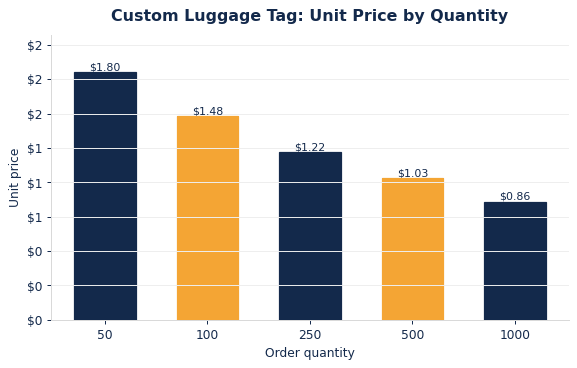
    Per-unit cost on custom luggage tags falls steadily with volume as setup amortizes across more pieces, so ordering for real demand rather than a token first batch is usually the efficient move. The curve below shows how pricing typically improves with quantity, which helps you plan an order that balances cash and cost.

    Typical per-unit luggage tags pricing as order quantity increases.
    Typical per-unit luggage tags pricing as order quantity increases.
    Ordering for a recurring need? A single larger run lowers the unit cost and keeps your branding consistent, while a small overage covers reorders and the occasional damaged piece without a rush order.

    Common mistakes to avoid

    A few avoidable missteps account for most disappointing luggage tags orders. Ordering before measuring is the biggest, followed by choosing a material for price alone without considering how the luggage tags will actually be used, and skipping the proof on a large run. Each is easy to prevent with a few minutes of planning, and each is expensive to fix once a full order is produced.

    The other common trap is over-designing the artwork. Cramming in too many colors, effects, or details can muddy the print and raise the cost, especially on textured or recycled materials. Simplifying the design to a clean, legible mark almost always improves both the look and the price of your custom luggage tags.

    Frequently asked questions about custom luggage tags

    What material is best for custom luggage tags?

    It depends on the use: choose a recyclable or natural material for eco positioning, a coated or laminated option for vivid full-color print, and a premium build for gifting or high-end presentation. Request a sample to judge feel and print before a full run of custom luggage tags.

    How do I choose the right size?

    Measure the product or use the luggage tags serves, then size to it with a small margin so the fit is clean without wasting material. When a measurement falls between standard options, size up slightly and confirm the size and format on a proof before ordering in volume.

    How are custom luggage tags branded?

    Pad printing and full-color wraps place logos vividly, with engraving or embossing for an upscale, permanent mark. Match the method to your artwork and budget, keep the art vector where possible, confirm the print area for your size, and approve a proof so the finished custom luggage tags match your intent.

    How does pricing work, and is there a minimum?

    Per-unit cost drops with quantity as setup amortizes across the run, so larger orders are more cost-effective. Order for real demand plus a small overage rather than a token batch, and consolidate recurring needs into one run for the best price.

    Can I get a sample or proof before ordering?

    Yes, and it is strongly recommended. A physical sample lets you judge material and print, and a digital or physical proof confirms your artwork, color, and size and format before a full run — a small step that prevents a costly mistake on a large order.

    What do you need to quote custom luggage tags?

    To quote accurately we need the size and format or the product they serve, the quantity, your material preference, and your artwork or a description of the branding. With those details we can recommend the right material and size and give you pricing for the run, and a proof follows once the order is confirmed.

    Whatever you order, send vector artwork, confirm material and size and format, and approve a proof before production. For help matching custom luggage tags to a specific use, see our companion guide, our How to Choose Custom Luggage Tags for Your Brand, and explore our our shop to start your order.

    Ready to order custom luggage tags?

    Tell us your product, quantity, and branding and we’ll match the material, size, and decoration for you.

    Get a Quote