A luggage tag has one job that matters and one job that quietly works against you. Its job is to reunite you with your bag if it ever gets separated from you. Working against that is the fact that anything printed on the outside of a bag is visible to every stranger who walks past it in a terminal, on a carousel, or in a hotel lobby. Getting a tag right means maximizing the first job while minimizing the exposure of the second. Most people never think about the trade-off until a bag goes missing or, worse, until they realize a tag has been broadcasting their home address to a crowded airport for years.
This guide covers what actually belongs on a luggage tag, what to leave off or hide, and how to design or specify tags, whether for yourself or for a branded program, that stay useful without oversharing.
Why the tag still matters
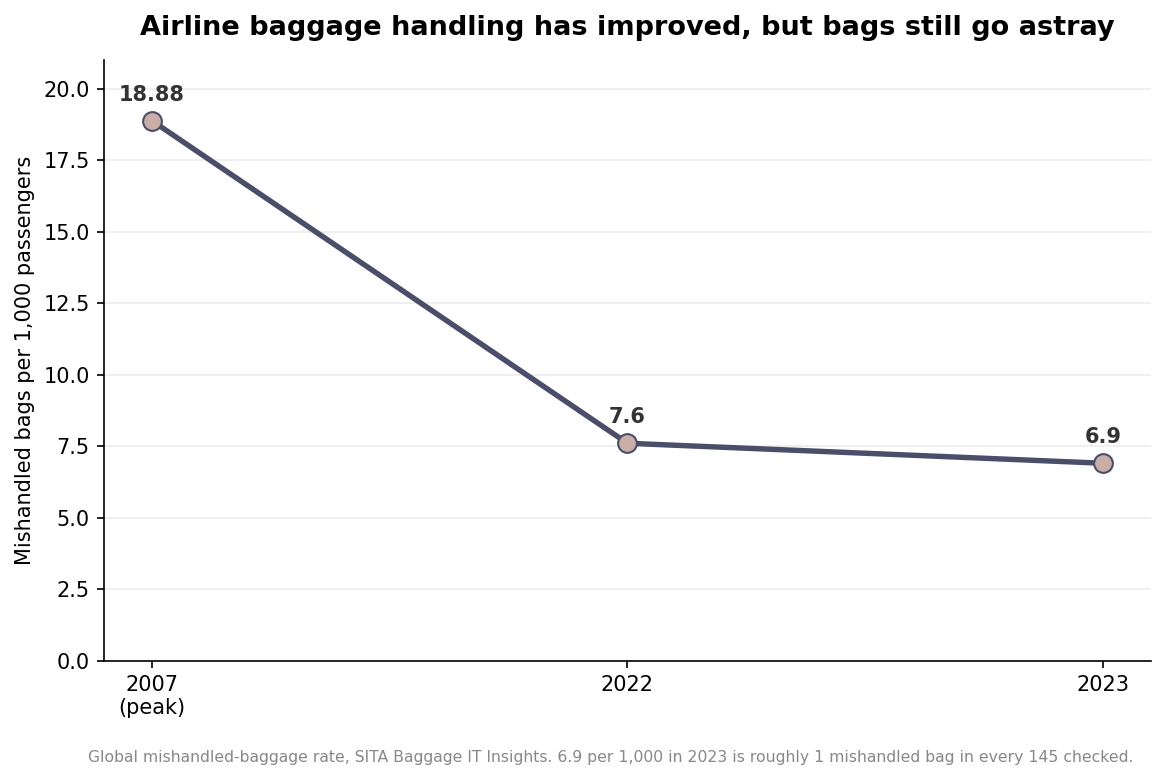
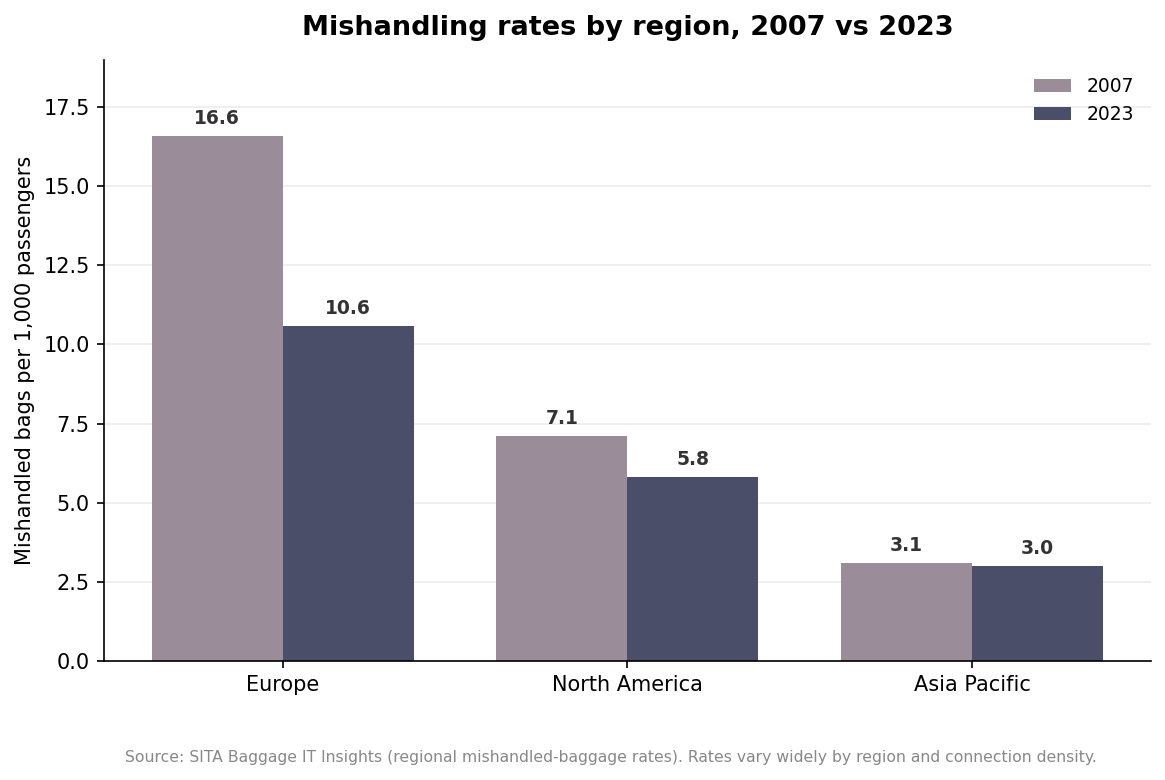
Airlines are better at handling bags than they used to be. Industry figures from SITA put the global mishandled-baggage rate at 6.9 bags per 1,000 passengers in 2023, down from 7.6 the year before and a fraction of the 2007 peak. That is a real improvement, and the trend line below shows how far it has come. But 6.9 per 1,000 still works out to roughly one mishandled bag in every 145 checked, and the rate varies sharply by region, staying much higher in connection-heavy markets. On a busy travel day, a lot of bags still end up temporarily in the wrong place.
When a bag is separated from its passenger, the airline’s own barcode tag is supposed to route it home. That tag can tear off, get soaked, or fail to scan, and it carries no way to reach you directly. Your personal tag is the backstop. Regional data makes the point that mishandling is not a rare, exotic event but a routine operational reality that a good tag is designed to survive.
The information worth printing
Keep the front of the tag to the minimum that lets an honest finder reach you fast. A name is fine, though many travelers use just a first name or initials rather than a full legal name. The single most important field is a reachable contact that is not tied to your front door: a phone number or, better, an email address you check on the road. Using a dedicated travel email rather than your primary inbox is a small step that keeps your main account private if the tag is photographed.
A destination-side contact can help, but handle it carefully. Listing the hotel you are staying at tells a stranger both that you are away from home and exactly where to find your belongings, so if you include arrival information at all, keep it vague or write it where it is not casually visible. Finally, a short verification code or PIN known only to you is a quiet upgrade: if someone claims to have found your bag, you can ask them to read it back before you share more, which deters the opportunist who simply wants to know where you live.
What to leave off or hide
The clearest mistake is a full home address printed openly on the outside of the bag. It announces, to anyone who glances at the carousel, both that the house may be empty and precisely where it is. If you want a return address on the tag at all, the standard advice from travel-gear guidance is to write it on the back of the insert or behind a cover so it is hidden from casual view, and to rely on the phone or email on the front for the actual reunion.
Leave off your full itinerary, flight numbers, and hotel details on any exposed surface, since those reveal more about your movements than a finder needs and more than you would want a stranger to have. Skip your primary email if you can, for the reasons above. The guiding principle is simple: print what a helpful person needs to contact you, and hide anything that would help a dishonest person locate you or your empty home.
Design choices that protect privacy
The physical design of the tag does as much for privacy as the text on it. A covered or flap-style tag, where the details sit behind an opaque or fold-over panel rather than in an open window, means the information is available to someone who deliberately looks but not broadcast to everyone in line. This is the single most effective privacy feature and costs almost nothing.
A QR code can replace printed contact details entirely, and the smart way to implement it is to have the code resolve to a simple contact form or a masked relay rather than exposing your raw phone number and email in the code itself. That lets a finder reach you while keeping your actual details unreadable to a casual scanner. Pair any external tag with an inside-the-bag ID card placed on top of your belongings, so that if the external tag is torn away, ground staff opening the bag to identify it still find a way to reach you. Because external tags do get ripped off in transit, that internal backup is what turns a lost bag into a found one.
Specifying tags for a brand or bulk program
If you are ordering tags for customers, staff, or an event rather than for yourself, the same privacy logic should shape the product itself. Favor a design with a covered window or write-on insert so each recipient controls what shows and can update it, rather than permanently printing personal data that will be wrong the moment someone moves. For fixed branding, put the logo and any brand contact on the outside and reserve the personal fields for a replaceable insert behind a cover.
Material and attachment still decide whether the tag survives to do its job. Sturdier materials such as leather, thick PVC, or metal outlast the flimsy paper tags airlines hand out, and a secure attachment, a steel cable or a strap threaded through the handle rather than a thin plastic loop, is what keeps the tag on the bag through rough transfers. A privacy-smart tag that falls off in the first connection protects nothing. Specify the cover, the insert, the material, and the attachment together, and you end up with tags that are both discreet and genuinely useful, which is the whole point of putting a tag on a bag in the first place.
Leave a Reply