Category: Uncategorized

  • Metal Luggage Tags: Aluminum, Stainless Steel and Brass Compared

    Metal Luggage Tags: Aluminum, Stainless Steel and Brass Compared

    Metal luggage tags occupy a specific niche in the custom tag world: they are the ones buyers reach for when a leather patch feels too soft and a printed PVC tag feels too disposable. But “metal” is not one material. Aluminum, stainless steel, brass and zinc alloy behave differently on a moving bag, take decoration differently, and land at very different price points. Choosing among them is really a decision about weight, how the artwork is applied, and how much abuse the tag will see in a cargo hold.

    This guide compares the metals used for custom luggage tags the way a buyer speccing a run of a few hundred should think about them: what each one is good at, where it fails, and how to write a specification that holds up.

    Why the metal matters more than the logo

    Every metal tag is a small trade-off between weight, corrosion resistance and how cleanly it carries a mark. Aluminum is the lightweight workhorse. At roughly 2.7 grams per cubic centimeter it weighs about a third of the same-size stainless steel tag, and its naturally forming oxide layer resists corrosion without plating. Most aluminum luggage tags are made from thin sheet in the 0.03 to 0.06 inch range, which is stiff enough to survive a zipper pull without being heavy on it.

    Stainless steel is the near-indestructible option. Grade 304 is the common choice, and it shrugs off scratches, salt air and years of baggage handling. The catch is weight and cost: it is dense, harder to cut and engrave, and it usually arrives thicker, in the 0.8 to 1.2 millimeter band. Brass is heavier still and prized mostly for looks. It engraves crisply and develops a warm patina over time, which some brands want and others do not. Zinc alloy sits in the middle, and it is typically die-cast into shaped or three-dimensional tags rather than cut from flat sheet.
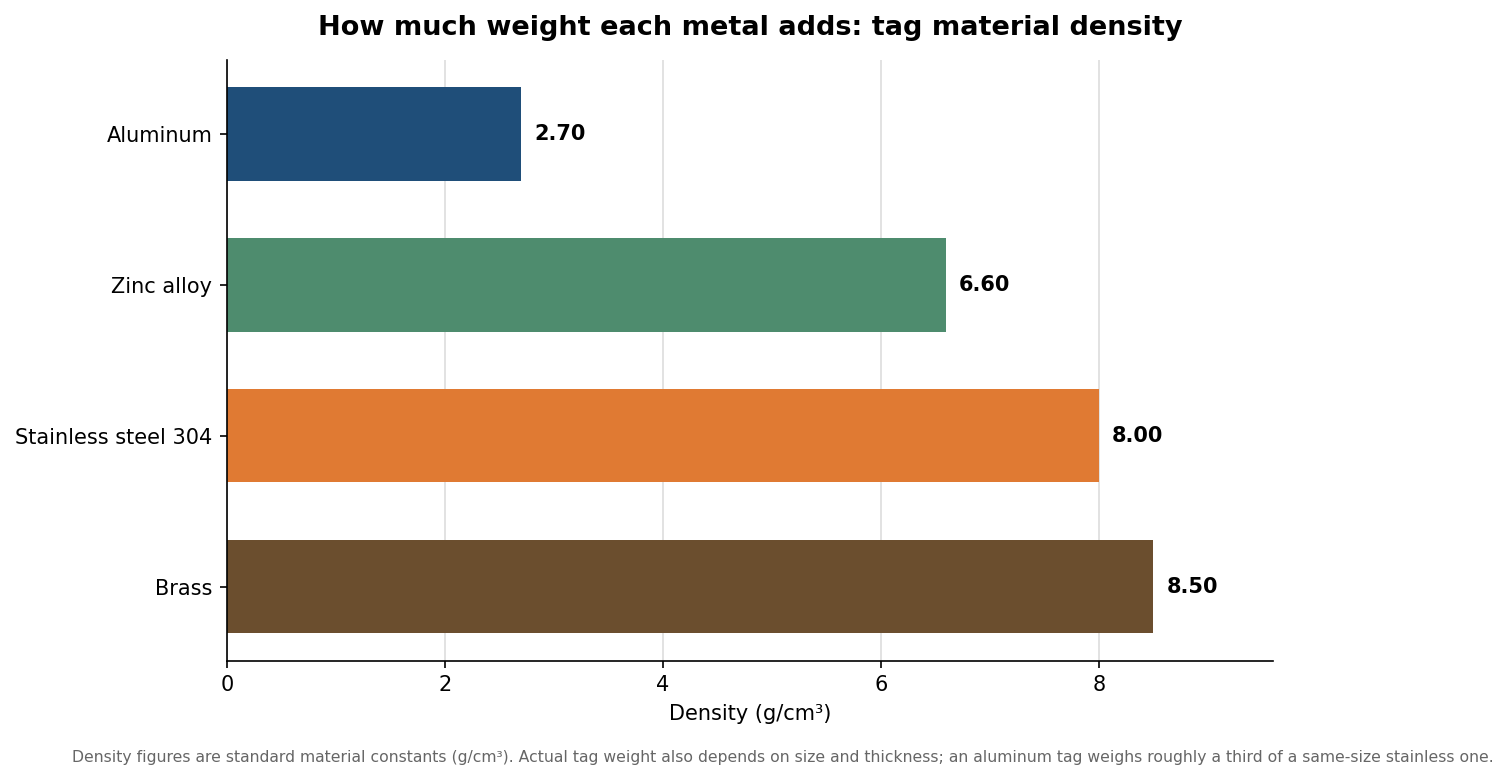
    Horizontal bar chart comparing the density of aluminum, zinc alloy, stainless steel and brass in grams per cubic centimeter
    Aluminum weighs roughly a third of a same-size stainless steel or brass tag.

    The density gap is not academic. A large 4-by-2.5 inch stainless tag on a lightweight garment bag can feel like a small padlock swinging from the handle, while an anodized aluminum tag of the same footprint barely registers. If the bag is checked, weight is a durability question too, because a heavier tag puts more load on whatever loop or strap attaches it.

    Anodized aluminum: light, colorful, and the frosty-white laser

    Anodized aluminum deserves its own section because it is the most common material for branded luggage tags, and for good reason. Anodizing grows a hard, dyed oxide layer into the surface of the metal rather than sitting on top of it, so color does not chip off the way paint would. Tags come in a small palette, commonly black, blue, red, gold and green, and a laser engraver burns through the dye to expose a frosty white aluminum underneath. That white-on-color contrast is the signature look of a promotional aluminum tag.

    A representative stock anodized tag runs about 2 by 3.875 inches with quarter-inch radius corners and a single slot, roughly 5/8 by 1/8 inch, for a strap. Both faces are engravable, so a logo can go on one side and a return address or QR code on the other. Beyond laser engraving, anodized blanks also accept UV-LED printing and toner heat transfer, which is how full-color artwork gets onto the tag when a single frosty-white mark is not enough.

    Stainless steel and brass: when the tag has to last for years

    If a tag is going onto a bag someone will carry for a decade, stainless steel earns its premium. It does not corrode, the edges stay sharp, and a deep engrave or a printed-and-baked graphic stays legible far longer than dye on aluminum exposed to constant abrasion. Stainless is the right call for premium luggage brands, frequent-flyer gifts and anything sold at a price point where a flimsy tag would undercut the product.

    Brass sits alongside it as the decorative choice. It is the heaviest of the common options, it engraves beautifully, and its patina is a feature for heritage or outdoors brands and a liability for anyone who wants the tag to look factory-fresh forever. If you go brass, decide up front whether you want it lacquered to hold its shine or left raw to age, because that finish choice changes the whole character of the tag.

    Decoration, cost and how they move together

    How you decorate the tag drives both the look and the price. Laser engraving on anodized aluminum is the cheapest, fastest path and the most forgiving at high quantities. Ink or UV printing adds color but adds cost, and full-color printing on aluminum or premium brushed-stainless tags sits at the top of the range. Across US promotional catalogs in mid-2026, custom metal luggage tags span roughly a dollar to eleven dollars per unit depending on material, size, decoration and how many you order. The chart below breaks that span down by decoration method; treat the numbers as indicative ranges rather than quotes, since quantity tier alone can move the per-unit price by several dollars.
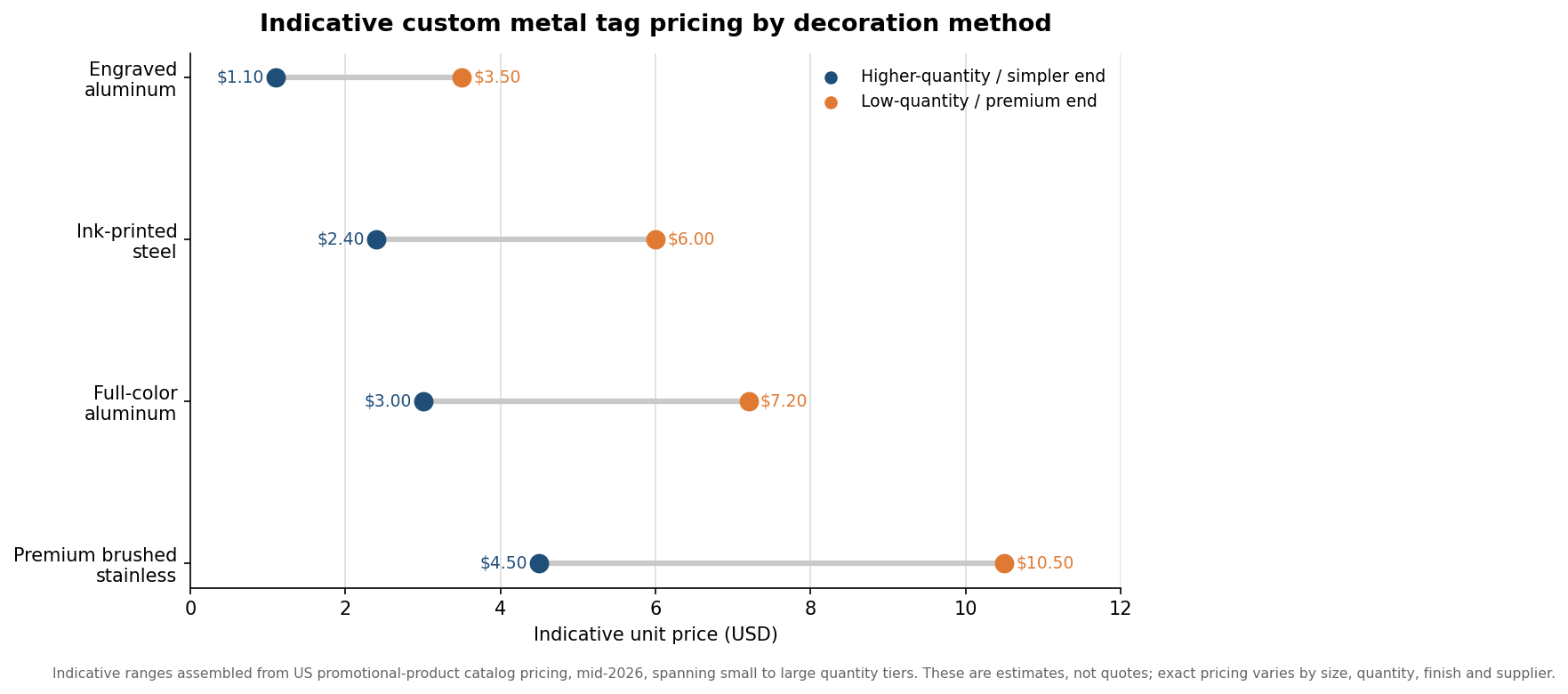
    Range plot of indicative custom metal luggage tag unit prices by decoration method, from engraved aluminum to premium brushed stainless
    Indicative per-unit price ranges by decoration method; quantity tier alone shifts the price several dollars.

    Two patterns hold across almost every supplier. First, per-unit price falls sharply as quantity rises, so a 500-piece order is dramatically cheaper each than a 50-piece one. Second, decoration complexity costs more than material in many cases: a full-color print on aluminum can cost more than a simple engrave on stainless. If budget is tight, a single-color engrave on anodized aluminum gives the most finished look per dollar.

    How to spec a metal tag that survives baggage handling

    Whatever metal you choose, the specification that matters most is the attachment, not the plate. A metal tag is only as reliable as the loop holding it on, and the weakest point is almost always a thin split ring or a plastic loop that fatigues and snaps. Stainless steel wire loops or aircraft-style cable straps outlast cheap rings by a wide margin, and they are worth specifying explicitly rather than accepting whatever a supplier defaults to.

    From there, keep it simple. Pick a thickness in the ranges above so the tag resists bending, confirm the slot size matches the strap you intend to use, and put contact details on the reverse face so the tag earns its keep if a bag goes missing. Order a single pre-production sample before committing to a few hundred pieces, because engraving depth, dye color and edge finish are all easier to judge in the hand than on a screen. Get those three things right, the material, the decoration and the loop, and a metal luggage tag will outlast several of the bags it rides on.
  • AirTag Luggage Tags vs QR and GPS: Choosing How Your Custom Tags Track a Bag

    AirTag Luggage Tags vs QR and GPS: Choosing How Your Custom Tags Track a Bag

    A luggage tag used to have one job: put a name on a bag so it could be returned. After several high-profile stretches of airline mishandling, buyers now want a tag that helps recover a bag, not just label it, and three very different technologies have moved onto the humble tag to do it. A scannable QR or ID tag, a Bluetooth tracker like an Apple AirTag tucked into a holder, and a live cellular GPS tag all promise “tracking,” but they work differently, cost wildly different amounts, and suit different buyers. If you are ordering branded tags in bulk, understanding the tradeoffs is what keeps you from over-buying technology your recipients will not use, or under-delivering on a premium travel gift.

    Three ways a tag can help find a lost bag

    The plainest option is a QR or ID tag. It carries no electronics; a finder scans a code or reads a number, and a contact relay connects them to the owner without exposing a home address. It costs almost nothing to run, works with any smartphone, and never needs a battery, but it is entirely passive: it only helps once a human finds the bag and chooses to scan it. A Bluetooth tracker such as an AirTag is the middle path. It does not contain GPS and cannot report its own position; instead it broadcasts a secure signal that nearby smartphones detect and relay to the owner through a crowd-sourced network. In busy airports and cities that network is dense enough to pinpoint a bag surprisingly well, but in an empty cargo hold or a remote area with no nearby phones, the location simply goes stale until the bag reaches people again. A cellular GPS tag is the only one that tracks live: it reads satellites and transmits coordinates over a cellular network every 15 to 60 seconds, anywhere with coverage. That capability comes with a mandatory data subscription, and that subscription is the whole story on cost.

    The Bluetooth tracker field, compared

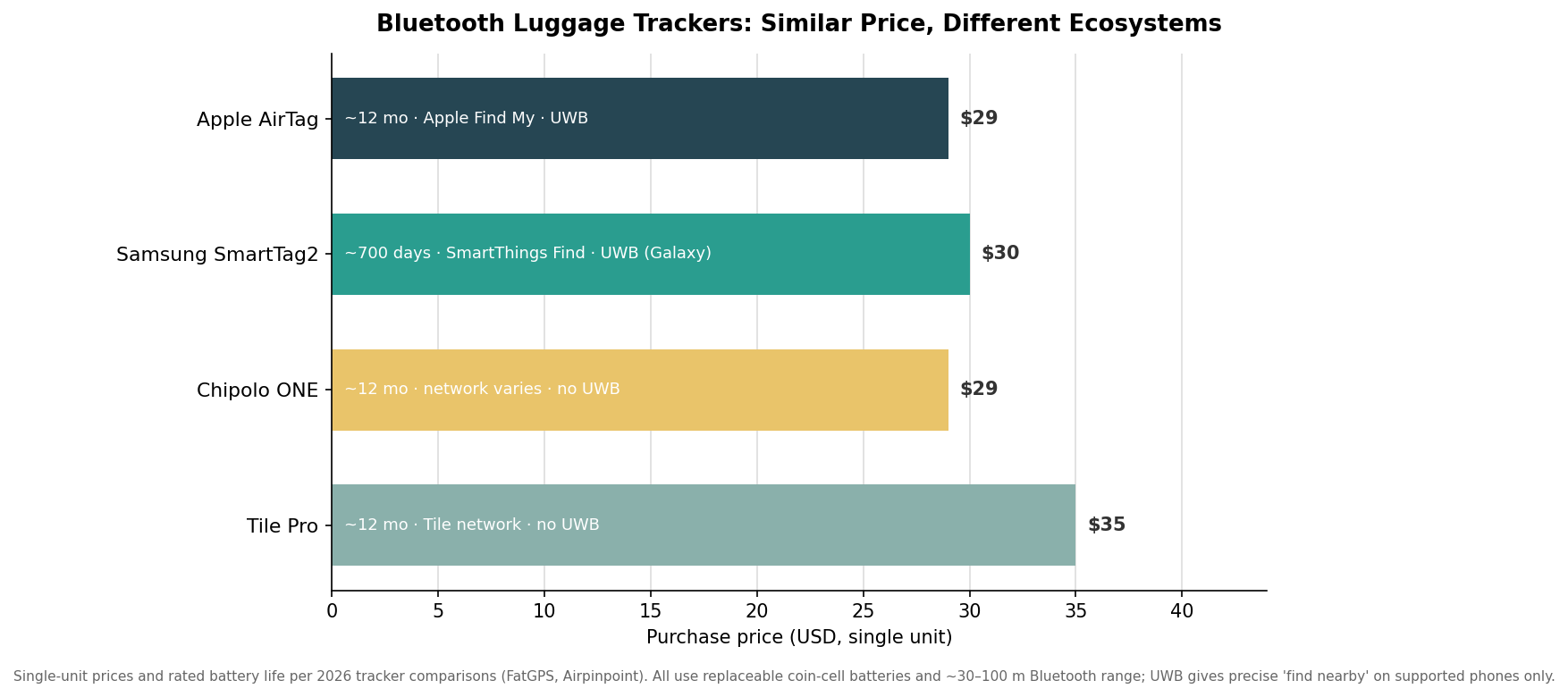
    Because Bluetooth trackers are the sweet spot for most travelers, they are worth comparing directly. The leading models sit within a few dollars of each other, so price is rarely the deciding factor; the ecosystem is. An AirTag only reaches its full potential inside Apple’s Find My network, a Samsung SmartTag2 is built for Galaxy phones and SmartThings Find, and cross-platform options like Tile and certain Chipolo variants trade the largest finding networks for the flexibility to work across phones. Ultra-wideband precision finding, which walks you the last few feet to a tag, is limited to AirTag and SmartTag2 on supported phones.

    Horizontal bar chart comparing purchase price and specs of AirTag, Samsung SmartTag2, Chipolo ONE and Tile Pro Bluetooth trackers
    The leading Bluetooth trackers cost within a few dollars of each other; the real difference is which phone ecosystem each serves.

    For a branded order, the practical implication is that you are effectively picking your recipients’ phone ecosystem for them. A corporate gift for a mixed-device workforce leans toward a cross-platform tracker or, more often, toward a well-made holder that lets each recipient drop in whichever tracker they already own. That last approach is why so many “AirTag luggage tags” are sold as holders rather than as a tag with a tracker built in: the traveler supplies the $29 tracker, and you supply the branded leather or silicone tag that carries it.

    What it really costs over a few years

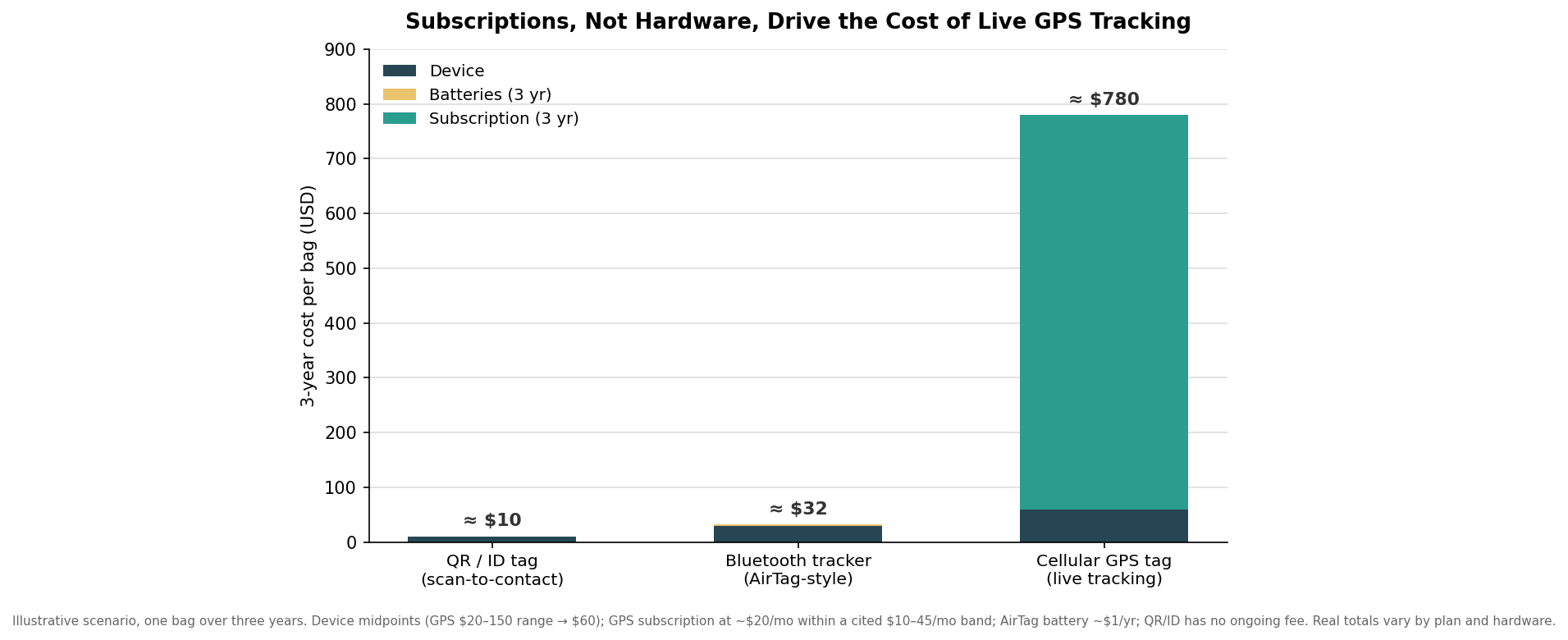
    The cost gap between these approaches is not about hardware; it is about subscriptions. A Bluetooth tracker is a one-time purchase around $29 with roughly a dollar a year in battery, and a QR or ID tag has no ongoing cost at all. A cellular GPS tag, by contrast, carries a monthly data fee commonly in the $10 to $45 range, which compounds into hundreds of dollars over the life of the tag.

    Stacked bar chart of illustrative three-year cost of ownership for QR/ID, Bluetooth tracker and cellular GPS luggage tags
    Over three years, the cellular GPS option’s subscription dwarfs the one-time cost of a Bluetooth tracker or QR tag.

    Seen over three years, the live-GPS option can cost more than twenty times a Bluetooth setup, almost entirely because of the subscription. That does not make GPS wrong; for a touring company tracking high-value equipment cases, live positioning anywhere on earth is worth the fee. But it is the wrong default for a consumer travel gift, where recipients will not maintain a subscription and a crowd-network Bluetooth tag delivers most of the reassurance at a fraction of the lifetime cost.

    Designing a branded tag around a tracker

    If you are building a tag to hold a tracker, a few physical decisions matter. An AirTag is about 1.26 inches across, roughly a third of an inch thick, and around 11 grams, so the holder pocket has to be cut to that footprint; a tag sized for a generic disc will let the tracker rattle or fall out. Decide whether the tracker should be concealed or visible: an enclosed pocket hides the device and looks cleaner, while an exposed ring shows it off but invites removal. Closure security is the quiet failure point, because a tracker in a snap pocket that pops open in transit is worse than no tracker at all; a screw-down or stitched-closed holder keeps both the device and your branding attached. And because the tag will travel hard, the same durability rules that apply to any luggage tag still hold: a secure strap and an abrasion-tolerant material matter as much as the tech inside.

    The travel fine print: airlines and privacy

    Two questions come up on every tracker-tag order. The first is whether they are even allowed in checked bags. They are: aviation authorities and the large majority of airlines permit AirTag-style trackers in checked luggage, since the small coin-cell battery falls well within the limits for lithium content. A brief airline concern a few years ago was reversed once regulators confirmed the batteries pose no meaningful risk, and today the trackers are routine in checked bags. The second question is privacy. Modern trackers include unwanted-tracking alerts that warn a person if an unknown tag is traveling with them, which is a feature to explain rather than fear, and the same privacy discipline that applies to any tag applies here: put a way to reach the owner on the tag, not a home address. A tracker locates the bag; the contact method returns it.

    Match the technology to the buyer and the budget follows. A QR or ID tag is the right default for broad, low-cost brand gifting where the goal is a returnable bag and a logo in a traveler’s hand. A tracker-ready holder is the premium travel or loyalty gift, giving recipients real find-my-bag capability without locking you into their phone brand. A live cellular GPS tag earns its subscription only for high-value or commercial tracking where knowing a bag’s position in real time, anywhere, is worth the recurring fee. Decide which of those three jobs your tag is really doing, and both the specification and the price fall into place.

  • What to Put on a Luggage Tag (and What to Leave Off)

    What to Put on a Luggage Tag (and What to Leave Off)

    A luggage tag has one job that matters and one job that quietly works against you. Its job is to reunite you with your bag if it ever gets separated from you. Working against that is the fact that anything printed on the outside of a bag is visible to every stranger who walks past it in a terminal, on a carousel, or in a hotel lobby. Getting a tag right means maximizing the first job while minimizing the exposure of the second. Most people never think about the trade-off until a bag goes missing or, worse, until they realize a tag has been broadcasting their home address to a crowded airport for years.

    This guide covers what actually belongs on a luggage tag, what to leave off or hide, and how to design or specify tags, whether for yourself or for a branded program, that stay useful without oversharing.

    Why the tag still matters

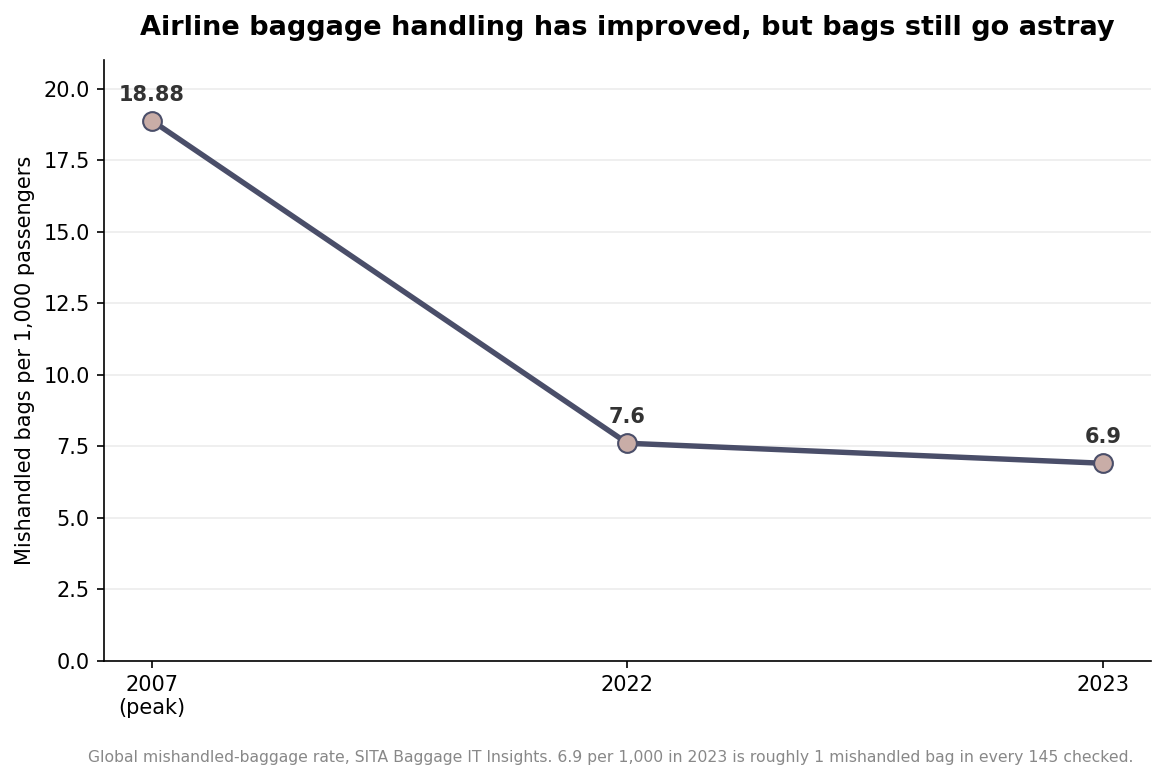
    Airlines are better at handling bags than they used to be. Industry figures from SITA put the global mishandled-baggage rate at 6.9 bags per 1,000 passengers in 2023, down from 7.6 the year before and a fraction of the 2007 peak. That is a real improvement, and the trend line below shows how far it has come. But 6.9 per 1,000 still works out to roughly one mishandled bag in every 145 checked, and the rate varies sharply by region, staying much higher in connection-heavy markets. On a busy travel day, a lot of bags still end up temporarily in the wrong place.

    Line chart of the global mishandled baggage rate falling from 18.88 per 1,000 in 2007 to 6.9 in 2023
    Baggage handling has improved sharply, but at 6.9 mishandled bags per 1,000 passengers in 2023, separations are still routine.

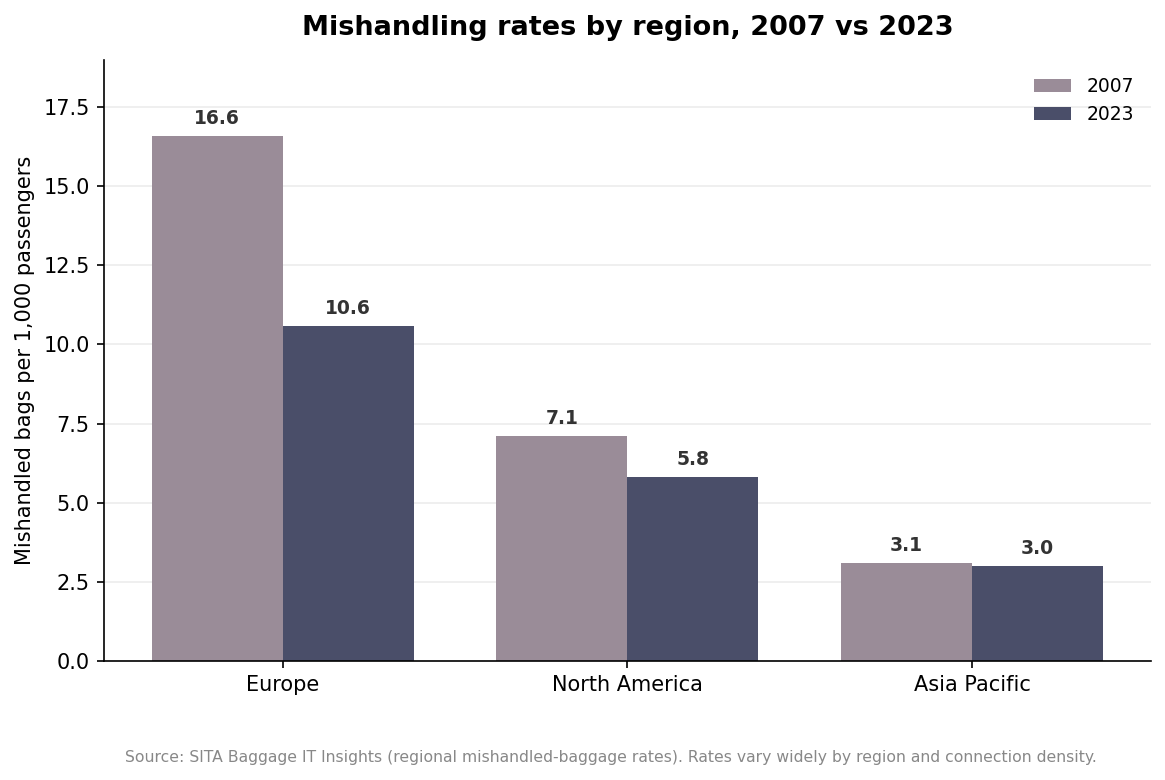
    When a bag is separated from its passenger, the airline’s own barcode tag is supposed to route it home. That tag can tear off, get soaked, or fail to scan, and it carries no way to reach you directly. Your personal tag is the backstop. Regional data makes the point that mishandling is not a rare, exotic event but a routine operational reality that a good tag is designed to survive.

    Grouped bar chart of mishandled baggage rates by region in 2007 versus 2023 for Europe, North America, and Asia Pacific
    Mishandling rates vary widely by region, staying highest where connections are dense, which is exactly where a good tag earns its keep.

    The information worth printing

    Keep the front of the tag to the minimum that lets an honest finder reach you fast. A name is fine, though many travelers use just a first name or initials rather than a full legal name. The single most important field is a reachable contact that is not tied to your front door: a phone number or, better, an email address you check on the road. Using a dedicated travel email rather than your primary inbox is a small step that keeps your main account private if the tag is photographed.

    A destination-side contact can help, but handle it carefully. Listing the hotel you are staying at tells a stranger both that you are away from home and exactly where to find your belongings, so if you include arrival information at all, keep it vague or write it where it is not casually visible. Finally, a short verification code or PIN known only to you is a quiet upgrade: if someone claims to have found your bag, you can ask them to read it back before you share more, which deters the opportunist who simply wants to know where you live.

    What to leave off or hide

    The clearest mistake is a full home address printed openly on the outside of the bag. It announces, to anyone who glances at the carousel, both that the house may be empty and precisely where it is. If you want a return address on the tag at all, the standard advice from travel-gear guidance is to write it on the back of the insert or behind a cover so it is hidden from casual view, and to rely on the phone or email on the front for the actual reunion.

    Leave off your full itinerary, flight numbers, and hotel details on any exposed surface, since those reveal more about your movements than a finder needs and more than you would want a stranger to have. Skip your primary email if you can, for the reasons above. The guiding principle is simple: print what a helpful person needs to contact you, and hide anything that would help a dishonest person locate you or your empty home.

    Design choices that protect privacy

    The physical design of the tag does as much for privacy as the text on it. A covered or flap-style tag, where the details sit behind an opaque or fold-over panel rather than in an open window, means the information is available to someone who deliberately looks but not broadcast to everyone in line. This is the single most effective privacy feature and costs almost nothing.

    A QR code can replace printed contact details entirely, and the smart way to implement it is to have the code resolve to a simple contact form or a masked relay rather than exposing your raw phone number and email in the code itself. That lets a finder reach you while keeping your actual details unreadable to a casual scanner. Pair any external tag with an inside-the-bag ID card placed on top of your belongings, so that if the external tag is torn away, ground staff opening the bag to identify it still find a way to reach you. Because external tags do get ripped off in transit, that internal backup is what turns a lost bag into a found one.

    Specifying tags for a brand or bulk program

    If you are ordering tags for customers, staff, or an event rather than for yourself, the same privacy logic should shape the product itself. Favor a design with a covered window or write-on insert so each recipient controls what shows and can update it, rather than permanently printing personal data that will be wrong the moment someone moves. For fixed branding, put the logo and any brand contact on the outside and reserve the personal fields for a replaceable insert behind a cover.

    Material and attachment still decide whether the tag survives to do its job. Sturdier materials such as leather, thick PVC, or metal outlast the flimsy paper tags airlines hand out, and a secure attachment, a steel cable or a strap threaded through the handle rather than a thin plastic loop, is what keeps the tag on the bag through rough transfers. A privacy-smart tag that falls off in the first connection protects nothing. Specify the cover, the insert, the material, and the attachment together, and you end up with tags that are both discreet and genuinely useful, which is the whole point of putting a tag on a bag in the first place.

  • Why Custom Luggage Tags Fall Off (and How to Spec One That Stays On)

    Why Custom Luggage Tags Fall Off (and How to Spec One That Stays On)

    A luggage tag has one job, and it fails at that job in a very specific way: it disappears somewhere between the check-in counter and the carousel. When it does, buyers usually blame the tag, but the tag is almost never the part that broke. The loop or strap that holds it to the bag is what gives out, and that piece is an afterthought on most orders. If you are buying custom tags in volume for a hotel, a travel brand, or a corporate program, a tag that goes missing is a branded impression you paid for and never got, plus a guest or client whose bag is now anonymous. Here is where the failures come from and how to specify around them.

    Most lost tags aren’t lost, the loop failed

    Walk the belt at any large airport and you will see orphaned tags and, more often, bare handles where a tag used to be. The plastic loop that ships free with most tags is the usual culprit. It works loose over a few flights, or it snaps outright, and the tag is gone while the bag travels on. The card itself is rarely the weak point; a printed or debossed panel survives being thrown around a cargo hold far better than the fastener threaded through its hole. That means the durability decision you actually need to make is about hardware, and it is the one most order forms bury under material and color choices.

    The worm loop problem: cheap, and cold

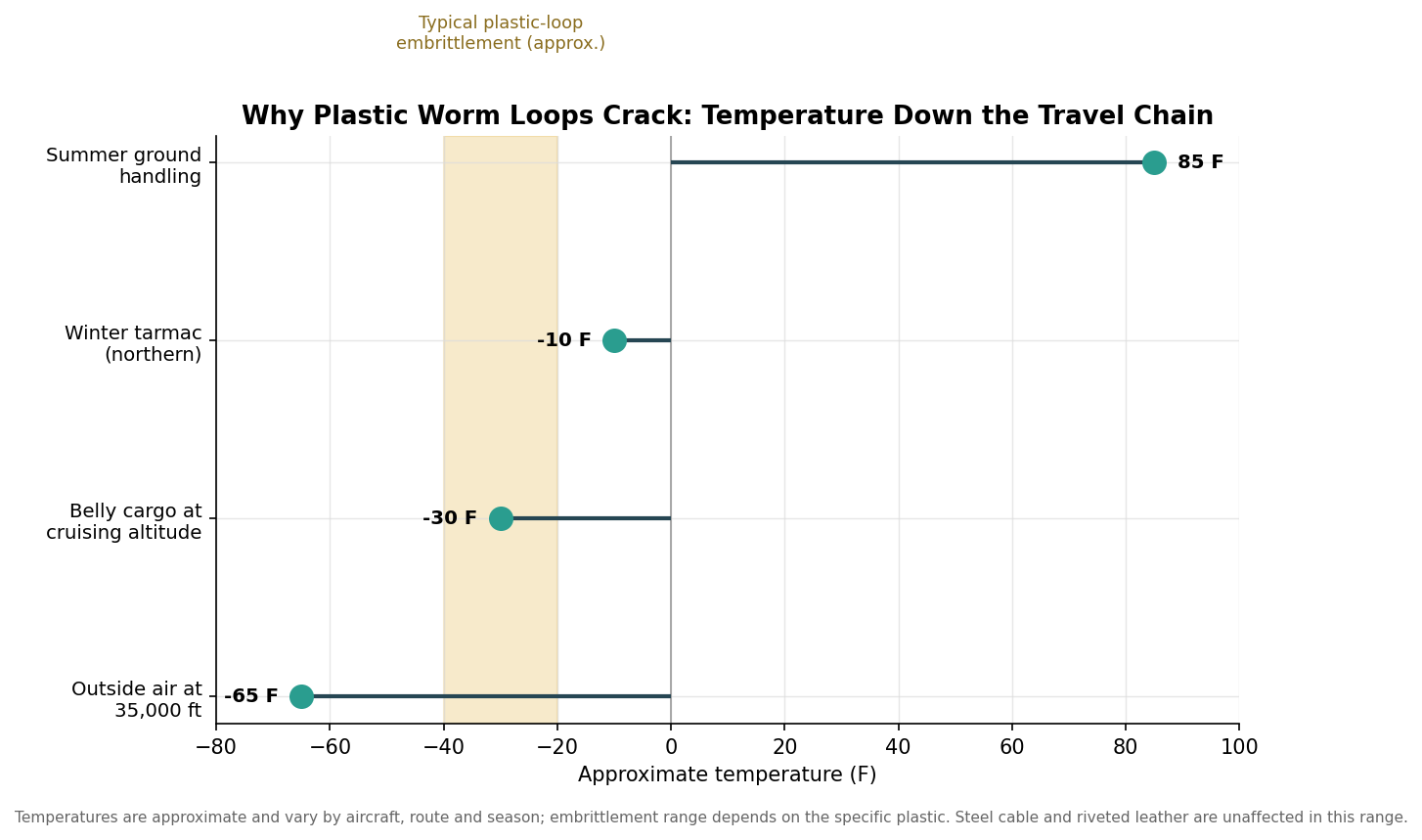
    The default fastener is the plastic worm loop, a ridged strip you thread through the tag and lock with a small nub. It is light and it costs almost nothing, which is exactly why it is the freebie. The trouble is temperature. Checked baggage does not stay at room temperature; it sits on winter tarmacs, rides in belly cargo, and endures the deep cold at cruising altitude, where outside air runs far below zero. Flexible plastics stiffen and turn brittle as they get cold, and a worm loop that was pliable at the counter can crack under a sharp tug on a freezing jet bridge.

    Lollipop chart of temperatures from summer ground handling to cruising altitude, with a shaded band showing where plastic loops embrittle
    Checked baggage routinely enters the temperature range where cheap plastic loops turn brittle and crack.

    The exact temperatures vary by aircraft, route, and season, and the point at which a given plastic embrittles depends on how it was formulated, so treat the figures above as directional rather than precise. The pattern, though, is reliable: the travel environment routinely visits the range where cheap plastic gives up, and the second failure mode, working loose from vibration, does not need cold at all. A worm loop that is not cinched genuinely tight walks itself open over a trip.

    The three attachments, and what each is for

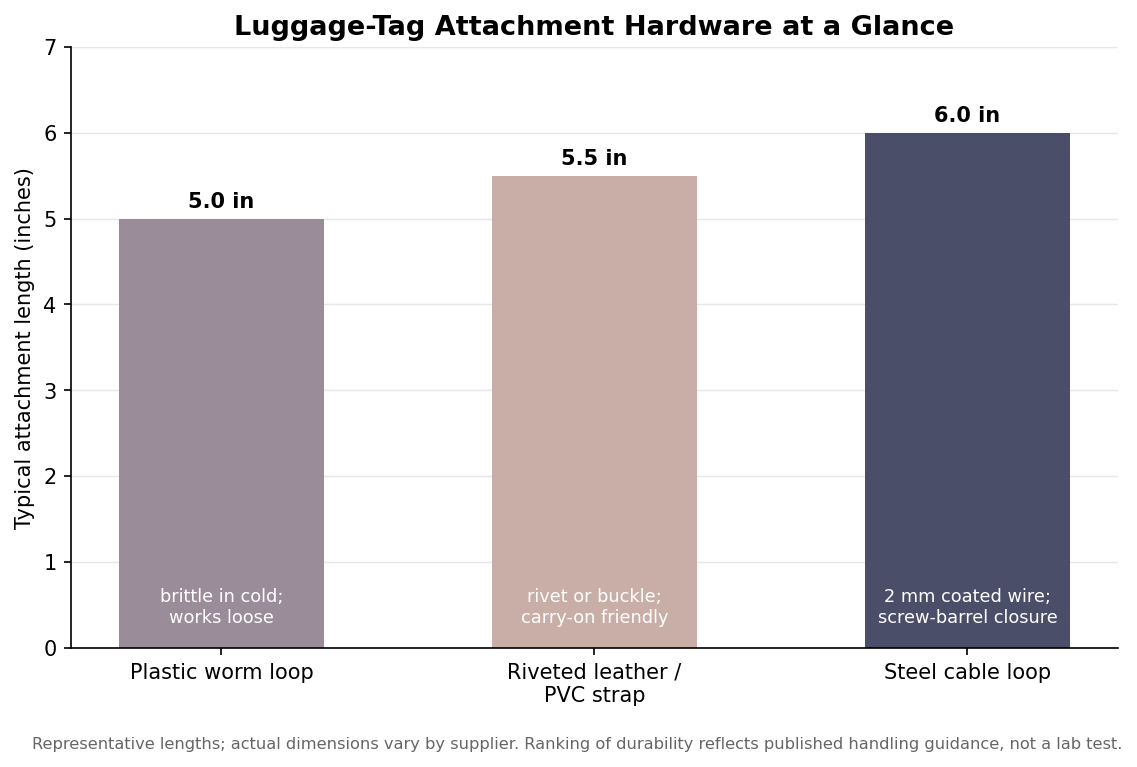
    There are really three choices, and they sort cleanly by use. The steel cable loop is the durable answer for checked bags: a roughly six-inch length of about 2 mm nylon-coated stainless wire that closes with a screw-together barrel, so there is no plastic to crack and no clasp to pop. It shrugs off conveyor belts and cold holds, at the cost of a little weight and a more utilitarian look. The riveted leather or heavy PVC strap sits in the middle: a thick strap fixed with a metal rivet or buckle looks the part on a carry-on or a premium gift, and it outlasts plastic by years while staying more refined than bare wire. The plastic worm loop earns its place only where cost per unit rules and the tags are semi-disposable, like a one-time event giveaway.

    Bar chart comparing typical length and traits of plastic worm loop, riveted leather/PVC strap, and steel cable loop luggage tag attachments
    The three fasteners sort by use: worm loops for disposable, straps for carry-on and gifts, steel cable for checked bags.

    Match the fastener to the life you expect the tag to have. A resort that hands tags to guests who will check bags for years should not be shipping worm loops; a wedding favor that travels home once can. The lengths above are representative and vary by supplier, and the durability order reflects published handling guidance rather than a controlled lab test, but the ranking holds up on any baggage belt.

    Where you attach it matters as much as what

    Even the best loop fails if it is put in the wrong place. The single most common installation mistake is clipping the tag to a zipper pull or a thin side handle instead of the main top carry handle. Zipper pulls flex and can tear off; side loops snag. The top handle is the anchor point built to take load, and a tag secured there and pulled tight is dramatically more likely to arrive with the bag. This also affects how you punch the tag: a round hole suits a wire cable loop, while a wider slot is what a flat strap needs to pass through, and a tag punched for one will not take the other cleanly. Deciding the fastener before the die is punched saves a mismatch that quietly weakens every unit.

    How to spec a tag that stays on

    Turn this into three lines on your next order. First, choose the fastener on purpose rather than accepting the default, and for anything that will fly checked, specify a steel cable loop or a riveted strap instead of a worm loop. Second, make sure the hole or slot is punched to match that fastener, so the hardware seats the way it should. Third, if your tags carry a brand and go to travelers, add a one-line care note or insert telling recipients to fasten the tag to the top handle and pull it tight, because the finest hardware still loses to a loose knot. Get those three right and the tag does the job you bought it for, which is to stay on the bag and keep your name on it for the length of the trip.

  • QR Code Luggage Tags: How Smart Tags Work and How to Specify Your Own

    QR Code Luggage Tags: How Smart Tags Work and How to Specify Your Own

    A luggage tag with a QR code turns a lost bag into a solvable problem. Instead of printing your home address on a paper insert for anyone at the carousel to read, a smart tag points a finder to a private contact channel: they scan, you get a notification, and you decide how much to share. For a brand ordering tags as travel gifts, event swag, or a retail line, the technology is worth understanding before you specify a run, because the tag body and the code behind it are two separate decisions.

    How a QR code luggage tag actually works

    The tag itself carries a printed or engraved QR code. When someone points a phone camera at it, the code resolves to a web address rather than to your raw details. That address usually opens a simple page where the finder can send a message or reveal whatever contact method you have chosen to expose. Modern phones read standard QR codes with the native camera app, so no dedicated application is required on the finder’s side for the basic recovery flow to work. Some vendors layer an app on top to streamline messaging or add tracking, but the baseline case is a plain camera scan.

    The privacy advantage is structural. A traditional tag shows a fixed block of text; a scan-based tag shows only what its owner has configured, and only at the moment of a scan. That means you can list an email or a forwarding number without ever printing your street address on the outside of a bag that sits unattended in cargo holds and hotel lobbies.

    Static versus dynamic codes, and why it matters

    A static QR code encodes its destination permanently. Whatever it pointed to on the day it was printed, it points to forever. A dynamic code instead encodes a short redirect that the owner can re-target later, which has three practical consequences. You can update the contact details behind a tag after it is printed, so a change of phone number does not turn a whole order into scrap. You can often enable scan notifications, so you learn the moment a bag is found rather than waiting for a call. And for a business printing tags in bulk, you avoid reprinting costs when information changes.

    The trade-off is dependence. A dynamic code relies on the redirect service staying online, and many of those services carry a subscription. Before committing a large branded run to one platform, confirm what happens to the codes if the vendor folds or you stop paying, since a redirect that goes dark takes the tag’s usefulness with it. A static code, by contrast, keeps working with no third party in the loop, at the cost of never being editable. For giveaways where you control the landing page yourself, a static code pointing at your own domain can be the more durable choice.

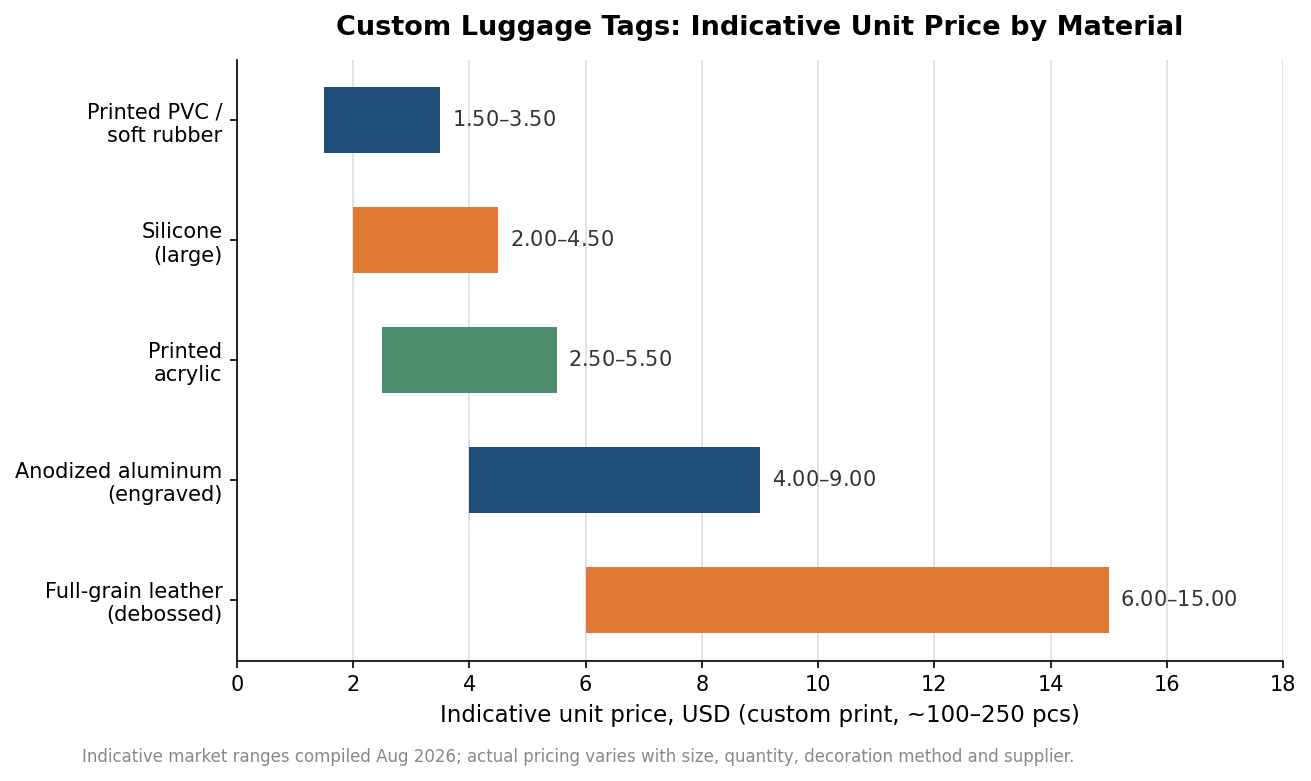
    Horizontal range bars showing indicative custom luggage tag unit prices by material, from printed PVC at $1.50-3.50 to full-grain leather at $6-15
    Indicative custom-print unit prices by material at moderate quantities; ranges vary with size and decoration.

    Choosing the tag body: material and size

    The code is only as reliable as the surface it rides on, and material is where most of the cost and durability differences live. Printed PVC and soft rubber tags are the workhorses of the category: lightweight, water resistant, cheap in volume, and forgiving of rough baggage handling. Silicone behaves similarly and flexes without cracking, which suits it to bags that get crushed into overhead bins. Anodized aluminum and full-grain leather move the product upmarket, trading a higher unit price for a premium feel that matters when the tag is a gift or a retail item rather than a functional label.

    Whatever the material, the QR code needs a quiet zone and enough physical size to scan cleanly. As a practical floor, keep the printed code at least around 20 by 20 millimeters with a clear margin around it, which most standard tag faces in the 50-to-90 millimeter range accommodate comfortably. Darker inks on light backgrounds scan most reliably; very glossy or metallic finishes over the code can defeat a camera under bright light, so it is worth proofing a sample scan before approving a full run.

    Specifying a custom run: quantity, decoration, and lead time

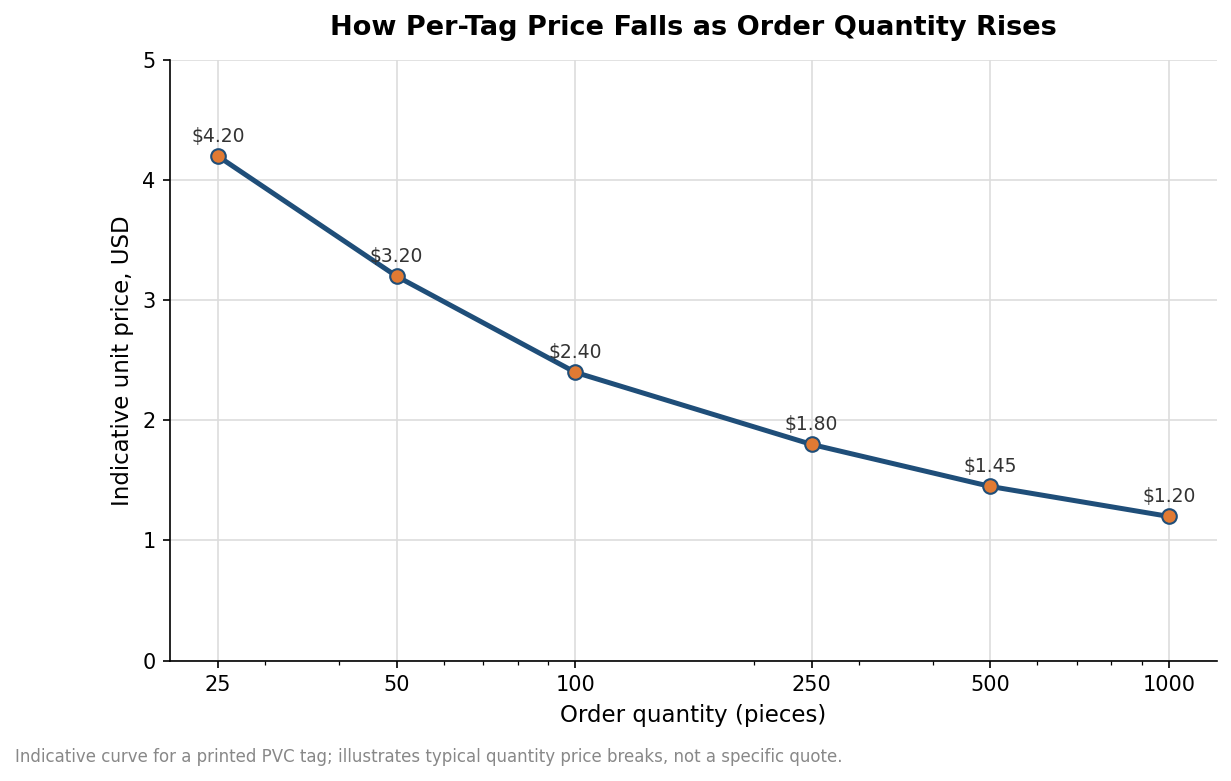
    Once material and code type are settled, the order specifics drive the invoice. Unit price falls steeply with quantity, which is the single biggest lever most buyers have. A run of a few dozen tags carries all the setup cost across very few pieces; the same tag ordered by the hundred or thousand spreads that fixed cost thin and can cut the per-tag price by half or more. If a tag is going into recurring gift bags or a store, ordering deeper is almost always cheaper per unit than repeated small batches.

    Decoration method interacts with material. Full-color printing suits PVC, silicone, and acrylic and reproduces a QR code and logo together in one pass. Metal and leather usually rely on engraving or debossing, which looks refined but reproduces a scannable QR code less reliably than print, so many premium tags pair an engraved logo with a separately printed or laser-marked code panel. On lead time, plan for a proof cycle plus production; a typical custom order runs on the order of two to three weeks from artwork approval, longer if you are sampling materials first or shipping internationally. Treat any single figure here as indicative, since it swings with decoration complexity and supplier backlog.

    Line chart showing indicative per-tag price falling from about $4.20 at 25 pieces to $1.20 at 1000 pieces
    Per-tag price drops sharply with order quantity, the biggest cost lever most buyers control.

    Where smart tags help, and where they do not

    A QR tag is a recovery aid, not a tracker. It does nothing until a human finds the bag and chooses to scan it, which makes it excellent for the lost-and-handed-in case and useless for locating a bag still moving through a mis-routed transfer. Travelers who want live location need a separate Bluetooth or GPS device; the two pair well, with the tracker telling you where the bag is and the QR tag telling a finder how to reach you. For a brand, the honest pitch is privacy and reunification, not surveillance.

    The category also rewards restraint in what you print. The whole point of a scan-based system is that the outside of the bag reveals nothing sensitive, so resist the temptation to add a name and phone number in plain text beside the code. Keep the visible face to a logo and the code, let the scan carry the contact details, and you get the branding benefit of a custom tag without reintroducing the exposure the QR code was meant to remove.

  • How Many Custom Luggage Tags Should You Order?

    Call or Text us: (929) 605-4397

    Home › Blog › How Many Custom Luggage Tags Should You Order?

    Ordering

    How Many Custom Luggage Tags Should You Order?

    07/01/2026

    Ordering custom luggage tags for the first time, most teams either wildly overestimate a giveaway or badly underestimate a standing gifting program — and both mistakes cost money. Overordering ties up budget in tags that sit in a supply closet; underordering means a rushed reorder at a worse per-unit price right when you need them most.

    The good news is the math is simpler than it looks once you separate your program into its actual use cases, because a one-time event favor, a launch giveaway, and a recurring gifting cadence all follow different logic.

    Start with your program type, not a round number

    Before picking a quantity, sort your need into one of three buckets: a fixed-headcount event or gift (a wedding, a conference, an executive gift list), a promotional giveaway (an open-ended handout at a booth or campaign), or a recurring program (an ongoing new-hire, new-client, or loyalty send). Each has a different right-sizing approach, and conflating them is the most common ordering mistake we see.

    Fixed-headcount events: count heads, then pad

    If you have a confirmed guest list or gift roster, add 10–15% for damaged-in-transit replacements, last-minute additions, and internal samples. A 200-guest wedding becomes a 230-tag order. Because our minimum is 100 units, this works cleanly for events from a hundred people up through several thousand.

    Promotional giveaways: estimate traffic and impressions

    For an open-ended handout, base the number on expected foot traffic or reach, not headcount. Trade-show booths commonly move 250–1,000 tags per day of a show; a campaign giveaway scales with your audience. Because printed PVC and silicone tags are the lowest-cost styles, this is where ordering a larger run pays off on per-unit price.

    Recurring programs: order a quarter or a year at once

    If you’re mailing a consistent new-hire or new-client tag, ordering a full quarter or year at once usually beats ordering in small batches on price, and gives production enough lead time that no single month gets rushed. A program sending 40 tags a month should order roughly 500 at once for a year, with a small buffer.

    Program typeHow to size itTypical order
    Event / gift listConfirmed count + 10–15% buffer100–1,000 units
    Promotional giveawayFoot traffic / reach based500–5,000+ units
    Recurring giftingOrder a quarter or year at once250–2,000 per order
    Multi-office or agencyCombine volume for pricing1,000–10,000+ units
    Key takeawaySize a fixed event off your confirmed count plus a 10–15% buffer, and order a recurring program by the quarter or year rather than the month for better pricing and lead time.

    The fastest way to get this right is to tell us your program type when you request a quote — we’ll ask the right follow-up questions and recommend a quantity that fits your budget and your calendar instead of leaving you to guess.

    More posts

  • Leather vs. PVC Luggage Tags: Which Material Fits Your Brand?

    Call or Text us: (929) 605-4397

    Home › Blog › Leather vs. PVC Luggage Tags: Which Material Fits Your Brand?

    Buyer guides

    Leather vs. PVC Luggage Tags: Which Material Fits Your Brand?

    06/18/2026

    The single biggest decision on any luggage tag order isn’t the shape or the strap — it’s the material. Leather and full-color PVC sit at opposite ends of the range on price, feel, and design freedom, and most programs only need to answer a few questions to know which one is right.

    Neither is objectively better. The right choice depends on your budget per unit, how the tag needs to feel in the hand, and whether your design relies on color.

    What a leather tag does best

    Genuine and vegan leather tags read as premium the instant someone picks one up. The material has weight, the debossed logo is part of the surface rather than printed on it, and leather ages well — it’s the tag people keep for years. That makes it ideal for executive gifts, hospitality, and any program where the tag is a keepsake and a lasting brand impression, not a throwaway.

    What a PVC tag does best

    Full-color PVC is the affordable, high-visibility workhorse. It prints edge-to-edge in unlimited CMYK, so multi-color logos, mascots, gradients, and custom die-cut shapes are all on the table, and it shrugs off rain and sun. At a fraction of the per-unit cost of leather, it’s the material for trade-show giveaways, group travel, sports teams, and any run measured on impressions per dollar.

    Cost and quantity differences

    Leather runs roughly $2.75–$9.00 per unit depending on genuine vs. vegan and decoration; PVC runs roughly $1.25–$3.25. On a 1,000-unit order that gap is real money, so the honest question is whether the audience and occasion justify the premium feel — a board-member gift, yes; a festival giveaway, probably not.

    Matching material to audience

    As a rule of thumb: leather for a discerning, smaller, keepsake-worthy audience; PVC for a broad, color-driven, budget-sensitive giveaway. Many programs order both — leather tags for VIPs and PVC tags for everyone else — and combine the volume to improve pricing on the whole order.

    FactorLeatherFull-Color PVC
    Best forExecutive gifts, hospitality, keepsakesGiveaways, groups, teams, promo
    DecorationDeboss / foil / engravingFull CMYK edge-to-edge
    Color rangeNatural tones + logoUnlimited, custom shapes
    Per-unit cost$2.75–$9.00$1.25–$3.25
    FeelPremium, weighty, ages wellLight, durable, weather-proof
    Key takeawayChoose leather when the tag is a keepsake for a discerning audience; choose PVC when the tag is a colorful, high-volume giveaway measured on impressions per dollar.

    Still deciding? Tell us your audience, budget, and quantity and we’ll recommend a material as part of your free mockup — and if it makes sense, we’ll split the order across both.

    More posts

  • Custom Luggage Tags for Corporate Gifting: A Buyer’s Guide

    Call or Text us: (929) 605-4397

    Home › Blog › Custom Luggage Tags for Corporate Gifting: A Buyer’s Guide

    Corporate

    Custom Luggage Tags for Corporate Gifting: A Buyer’s Guide

    06/03/2026

    Most corporate swag has a short life: a pen runs dry, a tote ends up in a closet, a stress ball hits the trash. A luggage tag is different, because it does a job the recipient actually needs done — it identifies their bag — and it does that job in public, on a suitcase handle, trip after trip.

    That combination of utility and visibility is why a well-made luggage tag is one of the highest-retention gifts a company can send. The trick is choosing one that reads as a gift rather than a giveaway.

    Why luggage tags get kept

    A gift gets kept when it’s useful and when it’s nice enough that throwing it out feels wasteful. A genuine or vegan leather tag with a clean debossed logo clears both bars: travelers need a tag, and a leather one is worth keeping. Every time that bag comes off a carousel, your logo is in someone’s hand and in a hundred strangers’ sightlines.

    Match the tag to the recipient

    Tier your gifting. Board members, top clients, and executive hires warrant a genuine leather or engraved aluminum tag that signals real investment. Broader employee or event gifting is well served by vegan leather or a clean printed tag at a lower per-unit cost. Ordering two tiers in one run keeps the premium pieces meaningful without blowing the budget on volume.

    Personalization raises retention

    A tag with just a logo is good; a tag with the recipient’s initials or name is kept forever. We can individually personalize leather deboss or metal engraving from a simple spreadsheet, which turns a nice gift into a personal one — especially effective for executive onboarding and top-client thank-yous.

    Plan around your gifting calendar

    Corporate gifting clusters around onboarding waves, year-end, and events. Because production runs about two weeks, order three to four weeks ahead of a hard date, and consider ordering a full year of new-hire tags at once to lock pricing and never scramble for a rush.

    Recipient tierRecommended materialPersonalization
    Board / top clientsGenuine leather or aluminumName or initials engraved
    Executive new hiresGenuine or vegan leatherInitials debossed
    Broad employee giftingVegan leather or PVCLogo only
    Event / conferencePVC or siliconeLogo + event year
    Key takeawayA luggage tag is useful and public, which is why it’s kept far longer than typical swag. Tier the material to the recipient and add personalization for the pieces that matter most.

    Tell us your recipient tiers and quantities and we’ll put together a gifting mockup — often across two materials — within one business day. Learn more about how we work on our about page, or browse more guides on the blog.

    More posts

  • Custom Luggage Tags for Hotels & Resorts

    Call or Text us: (929) 605-4397

    Home › Blog › Custom Luggage Tags for Hotels & Resorts

    Hospitality

    Custom Luggage Tags for Hotels & Resorts

    05/20/2026

    A great hotel stay ends at checkout, but the guest relationship doesn’t have to. A branded luggage tag placed in the welcome set or turndown gift travels home on the guest’s bag and keeps the property in view every time they fly — a marketing impression that costs pennies and lasts for years.

    For resorts and boutique hotels especially, where the whole business is built on a feeling, a tag that matches the property’s craft is an easy, high-retention way to extend that feeling.

    The tag as a post-stay touchpoint

    Guests keep useful, attractive objects. A leather tag with the property’s mark reads as a gift, not a promo item, so it goes straight onto a bag rather than into the bin. From then on it works as quiet advertising — on the guest’s future trips and in front of everyone who sees their luggage.

    Match the tag to the property

    The material should echo the property’s positioning. A luxury resort suits genuine leather or engraved aluminum; an eco-lodge suits wood; a lifestyle or beach brand suits bright vegan leather or silicone in the property’s colors. The tag is a small ambassador for the brand, so it should feel like the brand.

    Where the tag lives in the guest journey

    Consider placement: in the in-room welcome set, in a spa or loyalty-tier gift, at check-out as a parting thank-you, or bundled with a booking confirmation for returning guests. Each placement changes the quantity you need and the tier of tag that makes sense — a loyalty-tier gift can justify a nicer tag than a lobby giveaway.

    Ordering for a property

    Hotels typically reorder on a steady cadence, so lock your artwork once and reorder against it. Because we keep your specs on file, repeat runs match exactly and move quickly. Ordering a full season or year at once improves pricing and ensures you never run short during peak travel months.

    Property typeRecommended materialPlacement
    Luxury resortGenuine leather / aluminumTurndown or loyalty gift
    Boutique hotelVegan leatherIn-room welcome set
    Eco-lodgeWoodWelcome set / check-out
    Beach / lifestyleSilicone / PVCPool or activity giveaway
    Key takeawayA branded tag turns one stay into years of impressions. Match the material to the property’s positioning and place it where it reads as a gift, not a giveaway.

    Send us your property’s brand and a target quantity and we’ll mock up a tag that matches its feel within one business day — then keep your specs on file for effortless reorders.

    More posts

  • A Guide to Luggage Tag Sizes, Materials & Straps

    Call or Text us: (929) 605-4397

    Home › Blog › A Guide to Luggage Tag Sizes, Materials & Straps

    Buyer guides

    A Guide to Luggage Tag Sizes, Materials & Straps

    05/06/2026

    Before you order custom luggage tags, it helps to understand the three variables that shape every tag: size, material, and how it attaches. Get these right and the tag looks proportional, survives travel, and stays on the bag; get them wrong and you end up with a tag that’s too small to read or a strap that pops off in a baggage system.

    Here’s a practical walk through each so you can spec your order with confidence.

    Standard sizes and when to change them

    Most luggage tags land around 4 x 2.5 inches on the face — big enough for a clear logo and an ID card, small enough not to snag. Go larger only if your logo is wide or you want extra presence on a big checked bag; go smaller (around 3.75 x 1.75) for metal tags, where a compact footprint reads as premium and precise.

    Material trade-offs at a glance

    Leather is premium and ages well; vegan leather adds color range and a lower price; PVC is the cheapest and most colorful; aluminum is the most durable and upscale; wood is warm and eco-forward; silicone is unbreakable and kid-proof. Your audience, budget, and durability needs point to one or two of these quickly.

    How the tag attaches

    The strap matters more than people expect. A leather pull-through loop with a steel buckle suits leather and wood; a braided steel cable can’t be torn off and suits metal tags on rugged gear; an adjustable PVC or nylon loop suits printed tags; and a one-piece molded loop on a silicone tag has no parts to fail. Match the strap to the bag and the abuse it’ll see.

    The ID panel

    Decide how travelers add their details: a clear window with a printed address card, an engraved fixed panel, or a smooth write-on area. For gifting, a clear window is friendliest because the recipient fills it in themselves; for equipment tracking, an engraved or serialized panel is better.

    MaterialBest traitTypical strap
    Genuine leatherPremium, ages wellLeather loop + buckle
    Vegan leatherColor range, valueMatching PU loop
    PVCCheapest, full-colorAdjustable loop
    AluminumMost durable, upscaleSteel cable / leather
    WoodWarm, sustainableWaxed cord / leather
    SiliconeUnbreakable, kid-proofOne-piece molded loop
    Key takeawaySpec three things and you’re set: a face around 4 x 2.5 in (smaller for metal), a material matched to audience and budget, and a strap matched to the bag and the wear it’ll take.

    Not sure how to spec yours? Send us the use case and we’ll recommend size, material, and strap in your free mockup within one business day.

    More posts