Metal luggage tags occupy a specific niche in the custom tag world: they are the ones buyers reach for when a leather patch feels too soft and a printed PVC tag feels too disposable. But “metal” is not one material. Aluminum, stainless steel, brass and zinc alloy behave differently on a moving bag, take decoration differently, and land at very different price points. Choosing among them is really a decision about weight, how the artwork is applied, and how much abuse the tag will see in a cargo hold.
This guide compares the metals used for custom luggage tags the way a buyer speccing a run of a few hundred should think about them: what each one is good at, where it fails, and how to write a specification that holds up.
Why the metal matters more than the logo
Every metal tag is a small trade-off between weight, corrosion resistance and how cleanly it carries a mark. Aluminum is the lightweight workhorse. At roughly 2.7 grams per cubic centimeter it weighs about a third of the same-size stainless steel tag, and its naturally forming oxide layer resists corrosion without plating. Most aluminum luggage tags are made from thin sheet in the 0.03 to 0.06 inch range, which is stiff enough to survive a zipper pull without being heavy on it.
Stainless steel is the near-indestructible option. Grade 304 is the common choice, and it shrugs off scratches, salt air and years of baggage handling. The catch is weight and cost: it is dense, harder to cut and engrave, and it usually arrives thicker, in the 0.8 to 1.2 millimeter band. Brass is heavier still and prized mostly for looks. It engraves crisply and develops a warm patina over time, which some brands want and others do not. Zinc alloy sits in the middle, and it is typically die-cast into shaped or three-dimensional tags rather than cut from flat sheet.
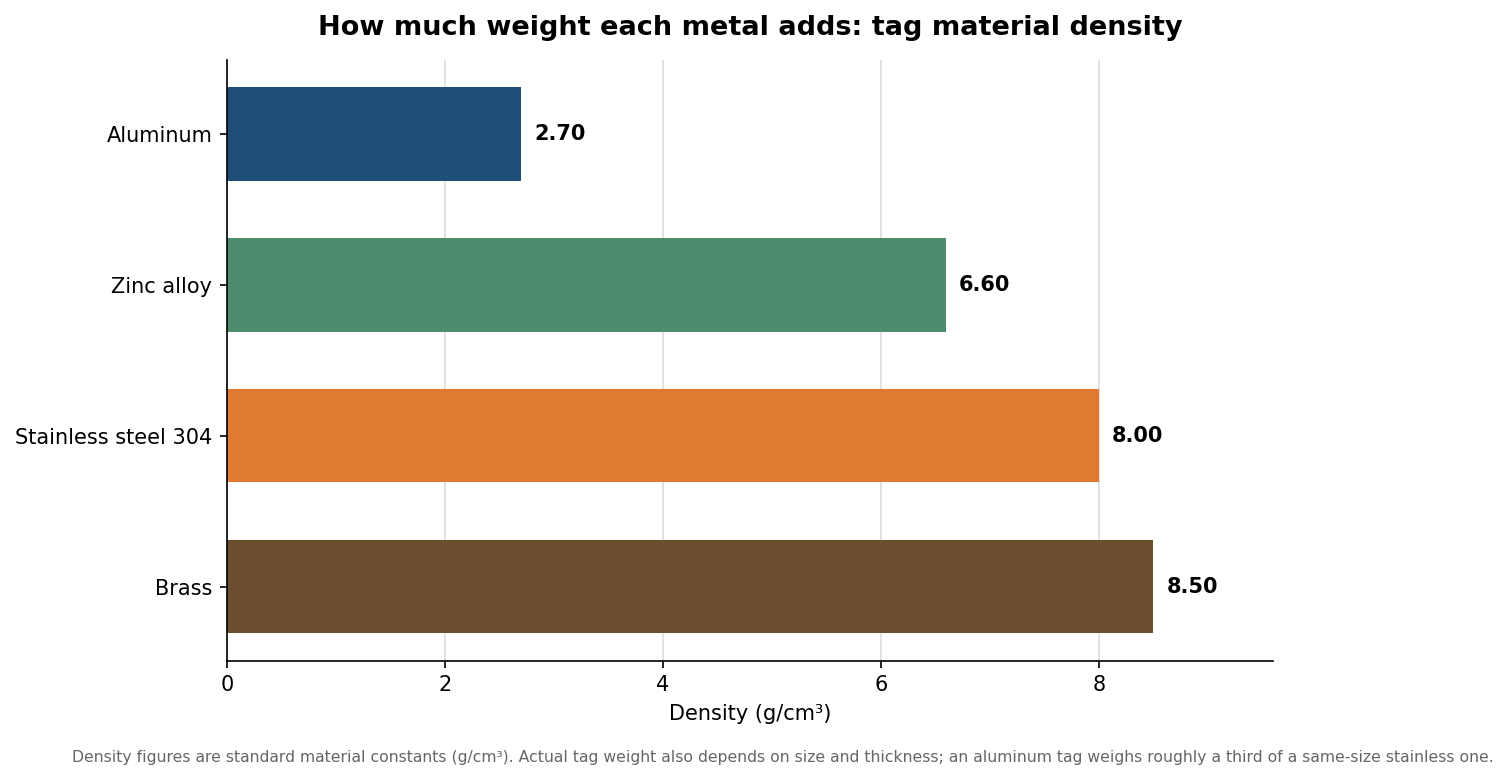
The density gap is not academic. A large 4-by-2.5 inch stainless tag on a lightweight garment bag can feel like a small padlock swinging from the handle, while an anodized aluminum tag of the same footprint barely registers. If the bag is checked, weight is a durability question too, because a heavier tag puts more load on whatever loop or strap attaches it.
Anodized aluminum: light, colorful, and the frosty-white laser
Anodized aluminum deserves its own section because it is the most common material for branded luggage tags, and for good reason. Anodizing grows a hard, dyed oxide layer into the surface of the metal rather than sitting on top of it, so color does not chip off the way paint would. Tags come in a small palette, commonly black, blue, red, gold and green, and a laser engraver burns through the dye to expose a frosty white aluminum underneath. That white-on-color contrast is the signature look of a promotional aluminum tag.
A representative stock anodized tag runs about 2 by 3.875 inches with quarter-inch radius corners and a single slot, roughly 5/8 by 1/8 inch, for a strap. Both faces are engravable, so a logo can go on one side and a return address or QR code on the other. Beyond laser engraving, anodized blanks also accept UV-LED printing and toner heat transfer, which is how full-color artwork gets onto the tag when a single frosty-white mark is not enough.
Stainless steel and brass: when the tag has to last for years
If a tag is going onto a bag someone will carry for a decade, stainless steel earns its premium. It does not corrode, the edges stay sharp, and a deep engrave or a printed-and-baked graphic stays legible far longer than dye on aluminum exposed to constant abrasion. Stainless is the right call for premium luggage brands, frequent-flyer gifts and anything sold at a price point where a flimsy tag would undercut the product.
Brass sits alongside it as the decorative choice. It is the heaviest of the common options, it engraves beautifully, and its patina is a feature for heritage or outdoors brands and a liability for anyone who wants the tag to look factory-fresh forever. If you go brass, decide up front whether you want it lacquered to hold its shine or left raw to age, because that finish choice changes the whole character of the tag.
Decoration, cost and how they move together
How you decorate the tag drives both the look and the price. Laser engraving on anodized aluminum is the cheapest, fastest path and the most forgiving at high quantities. Ink or UV printing adds color but adds cost, and full-color printing on aluminum or premium brushed-stainless tags sits at the top of the range. Across US promotional catalogs in mid-2026, custom metal luggage tags span roughly a dollar to eleven dollars per unit depending on material, size, decoration and how many you order. The chart below breaks that span down by decoration method; treat the numbers as indicative ranges rather than quotes, since quantity tier alone can move the per-unit price by several dollars.
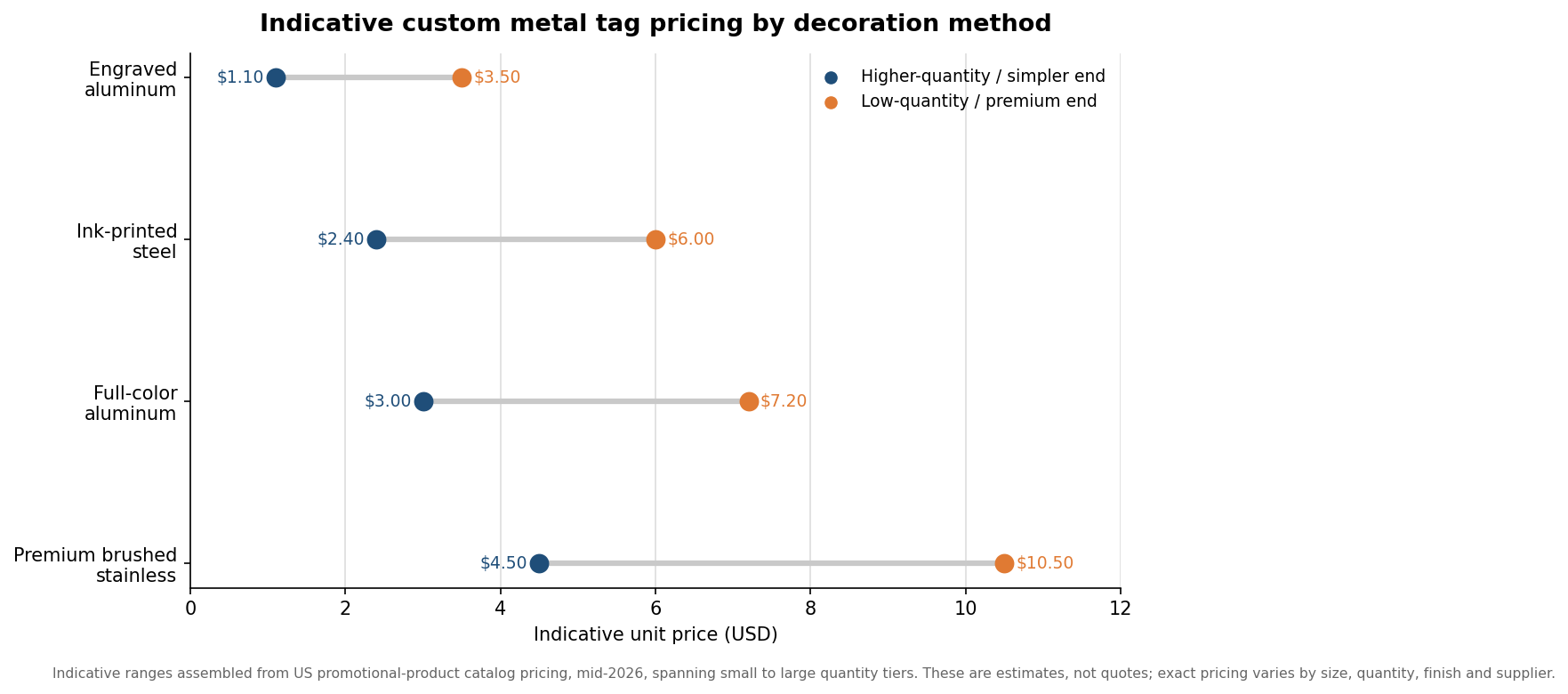
Two patterns hold across almost every supplier. First, per-unit price falls sharply as quantity rises, so a 500-piece order is dramatically cheaper each than a 50-piece one. Second, decoration complexity costs more than material in many cases: a full-color print on aluminum can cost more than a simple engrave on stainless. If budget is tight, a single-color engrave on anodized aluminum gives the most finished look per dollar.
How to spec a metal tag that survives baggage handling
Whatever metal you choose, the specification that matters most is the attachment, not the plate. A metal tag is only as reliable as the loop holding it on, and the weakest point is almost always a thin split ring or a plastic loop that fatigues and snaps. Stainless steel wire loops or aircraft-style cable straps outlast cheap rings by a wide margin, and they are worth specifying explicitly rather than accepting whatever a supplier defaults to.
From there, keep it simple. Pick a thickness in the ranges above so the tag resists bending, confirm the slot size matches the strap you intend to use, and put contact details on the reverse face so the tag earns its keep if a bag goes missing. Order a single pre-production sample before committing to a few hundred pieces, because engraving depth, dye color and edge finish are all easier to judge in the hand than on a screen. Get those three things right, the material, the decoration and the loop, and a metal luggage tag will outlast several of the bags it rides on.
Leave a Reply