A luggage tag used to have one job: put a name on a bag so it could be returned. After several high-profile stretches of airline mishandling, buyers now want a tag that helps recover a bag, not just label it, and three very different technologies have moved onto the humble tag to do it. A scannable QR or ID tag, a Bluetooth tracker like an Apple AirTag tucked into a holder, and a live cellular GPS tag all promise “tracking,” but they work differently, cost wildly different amounts, and suit different buyers. If you are ordering branded tags in bulk, understanding the tradeoffs is what keeps you from over-buying technology your recipients will not use, or under-delivering on a premium travel gift.
Three ways a tag can help find a lost bag
The plainest option is a QR or ID tag. It carries no electronics; a finder scans a code or reads a number, and a contact relay connects them to the owner without exposing a home address. It costs almost nothing to run, works with any smartphone, and never needs a battery, but it is entirely passive: it only helps once a human finds the bag and chooses to scan it. A Bluetooth tracker such as an AirTag is the middle path. It does not contain GPS and cannot report its own position; instead it broadcasts a secure signal that nearby smartphones detect and relay to the owner through a crowd-sourced network. In busy airports and cities that network is dense enough to pinpoint a bag surprisingly well, but in an empty cargo hold or a remote area with no nearby phones, the location simply goes stale until the bag reaches people again. A cellular GPS tag is the only one that tracks live: it reads satellites and transmits coordinates over a cellular network every 15 to 60 seconds, anywhere with coverage. That capability comes with a mandatory data subscription, and that subscription is the whole story on cost.
The Bluetooth tracker field, compared
Because Bluetooth trackers are the sweet spot for most travelers, they are worth comparing directly. The leading models sit within a few dollars of each other, so price is rarely the deciding factor; the ecosystem is. An AirTag only reaches its full potential inside Apple’s Find My network, a Samsung SmartTag2 is built for Galaxy phones and SmartThings Find, and cross-platform options like Tile and certain Chipolo variants trade the largest finding networks for the flexibility to work across phones. Ultra-wideband precision finding, which walks you the last few feet to a tag, is limited to AirTag and SmartTag2 on supported phones.
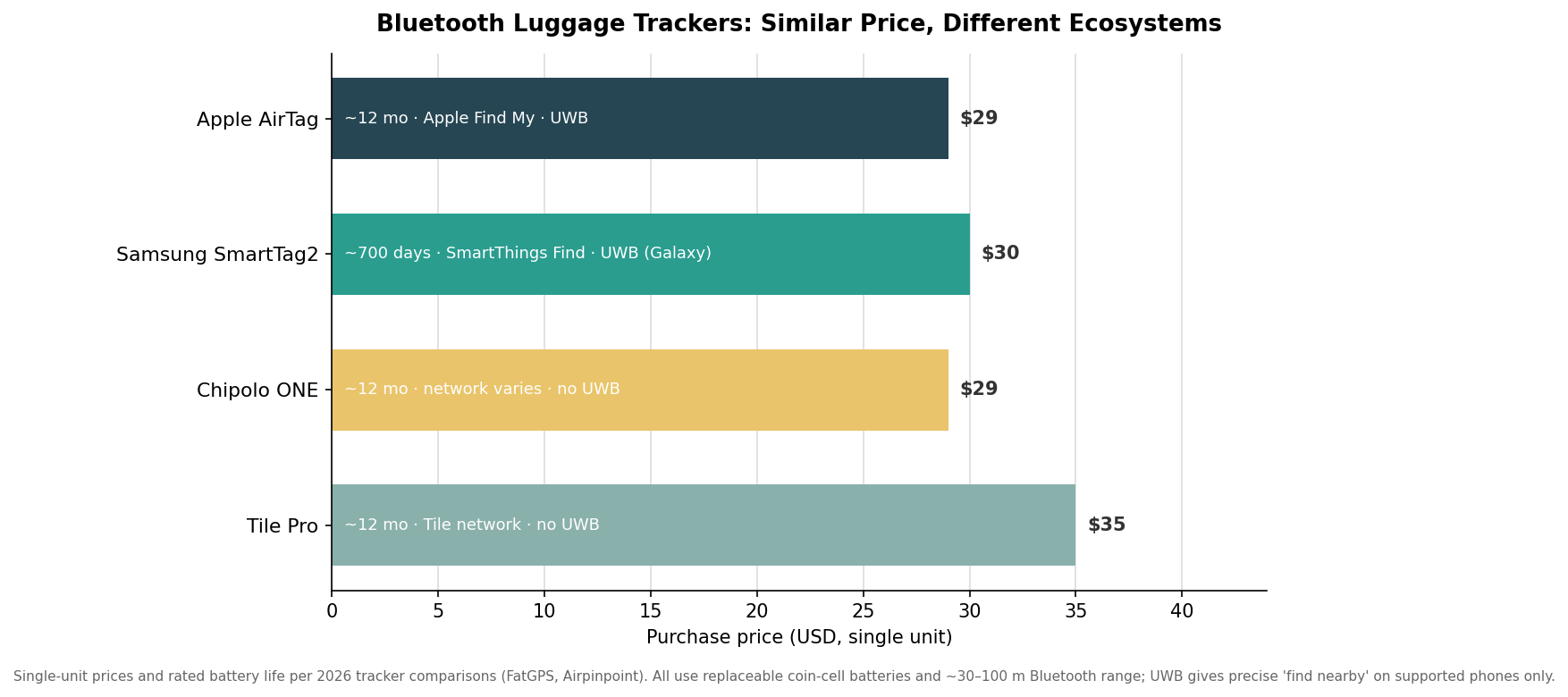
For a branded order, the practical implication is that you are effectively picking your recipients’ phone ecosystem for them. A corporate gift for a mixed-device workforce leans toward a cross-platform tracker or, more often, toward a well-made holder that lets each recipient drop in whichever tracker they already own. That last approach is why so many “AirTag luggage tags” are sold as holders rather than as a tag with a tracker built in: the traveler supplies the $29 tracker, and you supply the branded leather or silicone tag that carries it.
What it really costs over a few years
The cost gap between these approaches is not about hardware; it is about subscriptions. A Bluetooth tracker is a one-time purchase around $29 with roughly a dollar a year in battery, and a QR or ID tag has no ongoing cost at all. A cellular GPS tag, by contrast, carries a monthly data fee commonly in the $10 to $45 range, which compounds into hundreds of dollars over the life of the tag.
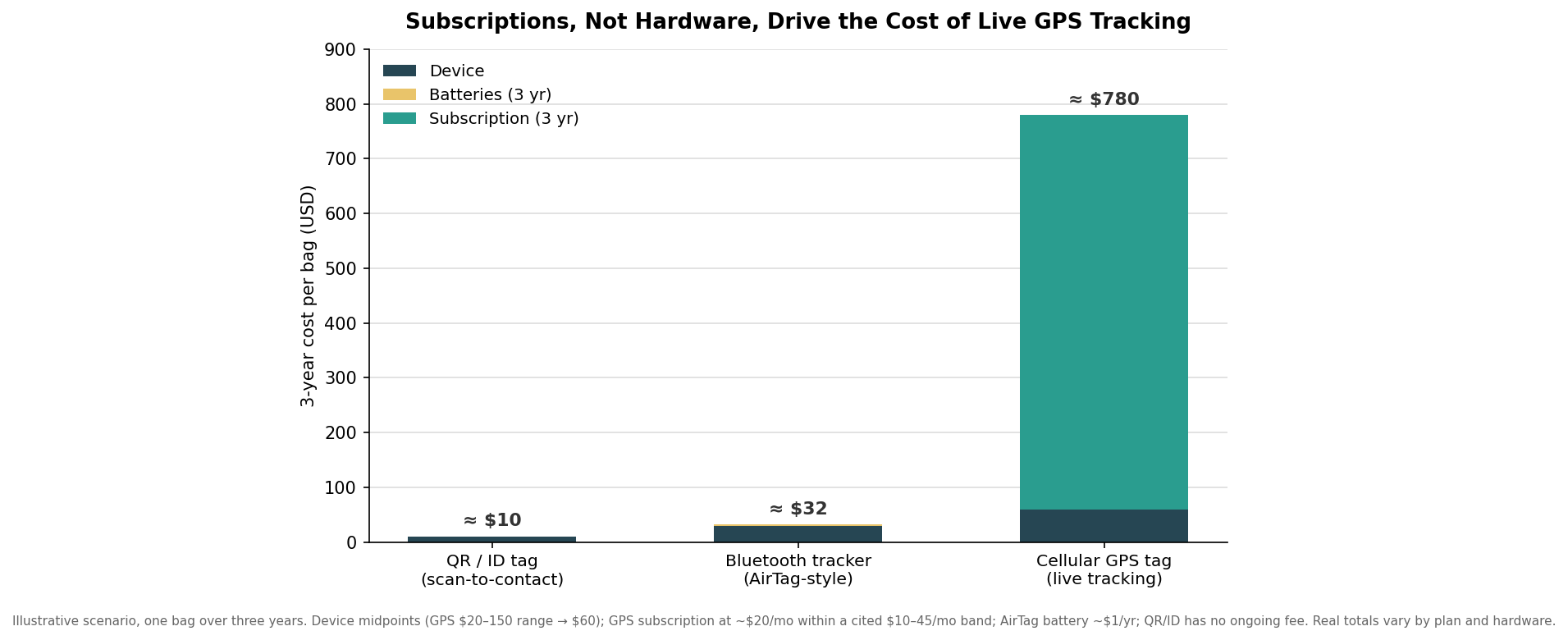
Seen over three years, the live-GPS option can cost more than twenty times a Bluetooth setup, almost entirely because of the subscription. That does not make GPS wrong; for a touring company tracking high-value equipment cases, live positioning anywhere on earth is worth the fee. But it is the wrong default for a consumer travel gift, where recipients will not maintain a subscription and a crowd-network Bluetooth tag delivers most of the reassurance at a fraction of the lifetime cost.
Designing a branded tag around a tracker
If you are building a tag to hold a tracker, a few physical decisions matter. An AirTag is about 1.26 inches across, roughly a third of an inch thick, and around 11 grams, so the holder pocket has to be cut to that footprint; a tag sized for a generic disc will let the tracker rattle or fall out. Decide whether the tracker should be concealed or visible: an enclosed pocket hides the device and looks cleaner, while an exposed ring shows it off but invites removal. Closure security is the quiet failure point, because a tracker in a snap pocket that pops open in transit is worse than no tracker at all; a screw-down or stitched-closed holder keeps both the device and your branding attached. And because the tag will travel hard, the same durability rules that apply to any luggage tag still hold: a secure strap and an abrasion-tolerant material matter as much as the tech inside.
The travel fine print: airlines and privacy
Two questions come up on every tracker-tag order. The first is whether they are even allowed in checked bags. They are: aviation authorities and the large majority of airlines permit AirTag-style trackers in checked luggage, since the small coin-cell battery falls well within the limits for lithium content. A brief airline concern a few years ago was reversed once regulators confirmed the batteries pose no meaningful risk, and today the trackers are routine in checked bags. The second question is privacy. Modern trackers include unwanted-tracking alerts that warn a person if an unknown tag is traveling with them, which is a feature to explain rather than fear, and the same privacy discipline that applies to any tag applies here: put a way to reach the owner on the tag, not a home address. A tracker locates the bag; the contact method returns it.
Match the technology to the buyer and the budget follows. A QR or ID tag is the right default for broad, low-cost brand gifting where the goal is a returnable bag and a logo in a traveler’s hand. A tracker-ready holder is the premium travel or loyalty gift, giving recipients real find-my-bag capability without locking you into their phone brand. A live cellular GPS tag earns its subscription only for high-value or commercial tracking where knowing a bag’s position in real time, anywhere, is worth the recurring fee. Decide which of those three jobs your tag is really doing, and both the specification and the price fall into place.
Leave a Reply