A luggage tag has one job, and it fails at that job in a very specific way: it disappears somewhere between the check-in counter and the carousel. When it does, buyers usually blame the tag, but the tag is almost never the part that broke. The loop or strap that holds it to the bag is what gives out, and that piece is an afterthought on most orders. If you are buying custom tags in volume for a hotel, a travel brand, or a corporate program, a tag that goes missing is a branded impression you paid for and never got, plus a guest or client whose bag is now anonymous. Here is where the failures come from and how to specify around them.
Most lost tags aren’t lost, the loop failed
Walk the belt at any large airport and you will see orphaned tags and, more often, bare handles where a tag used to be. The plastic loop that ships free with most tags is the usual culprit. It works loose over a few flights, or it snaps outright, and the tag is gone while the bag travels on. The card itself is rarely the weak point; a printed or debossed panel survives being thrown around a cargo hold far better than the fastener threaded through its hole. That means the durability decision you actually need to make is about hardware, and it is the one most order forms bury under material and color choices.
The worm loop problem: cheap, and cold
The default fastener is the plastic worm loop, a ridged strip you thread through the tag and lock with a small nub. It is light and it costs almost nothing, which is exactly why it is the freebie. The trouble is temperature. Checked baggage does not stay at room temperature; it sits on winter tarmacs, rides in belly cargo, and endures the deep cold at cruising altitude, where outside air runs far below zero. Flexible plastics stiffen and turn brittle as they get cold, and a worm loop that was pliable at the counter can crack under a sharp tug on a freezing jet bridge.
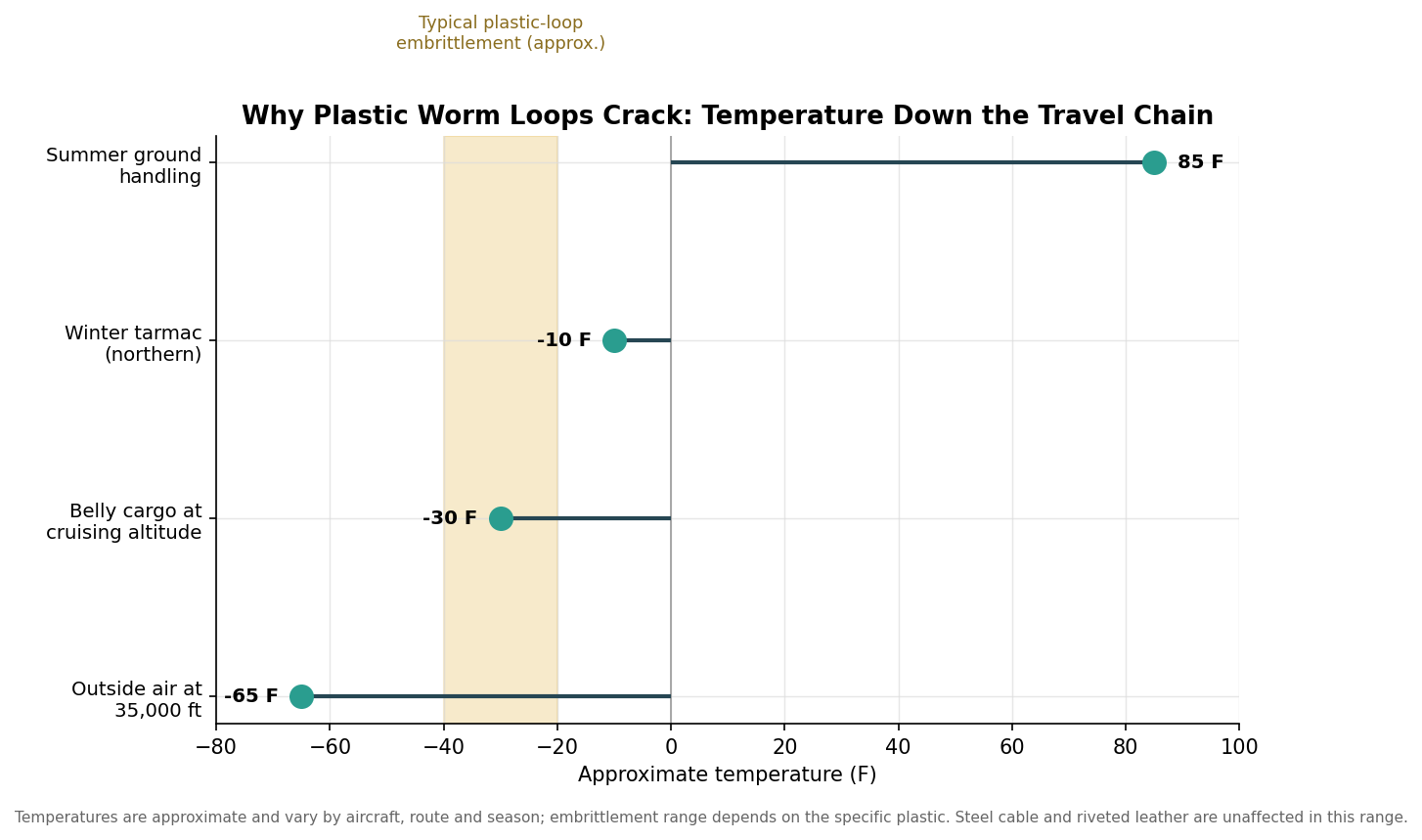
The exact temperatures vary by aircraft, route, and season, and the point at which a given plastic embrittles depends on how it was formulated, so treat the figures above as directional rather than precise. The pattern, though, is reliable: the travel environment routinely visits the range where cheap plastic gives up, and the second failure mode, working loose from vibration, does not need cold at all. A worm loop that is not cinched genuinely tight walks itself open over a trip.
The three attachments, and what each is for
There are really three choices, and they sort cleanly by use. The steel cable loop is the durable answer for checked bags: a roughly six-inch length of about 2 mm nylon-coated stainless wire that closes with a screw-together barrel, so there is no plastic to crack and no clasp to pop. It shrugs off conveyor belts and cold holds, at the cost of a little weight and a more utilitarian look. The riveted leather or heavy PVC strap sits in the middle: a thick strap fixed with a metal rivet or buckle looks the part on a carry-on or a premium gift, and it outlasts plastic by years while staying more refined than bare wire. The plastic worm loop earns its place only where cost per unit rules and the tags are semi-disposable, like a one-time event giveaway.
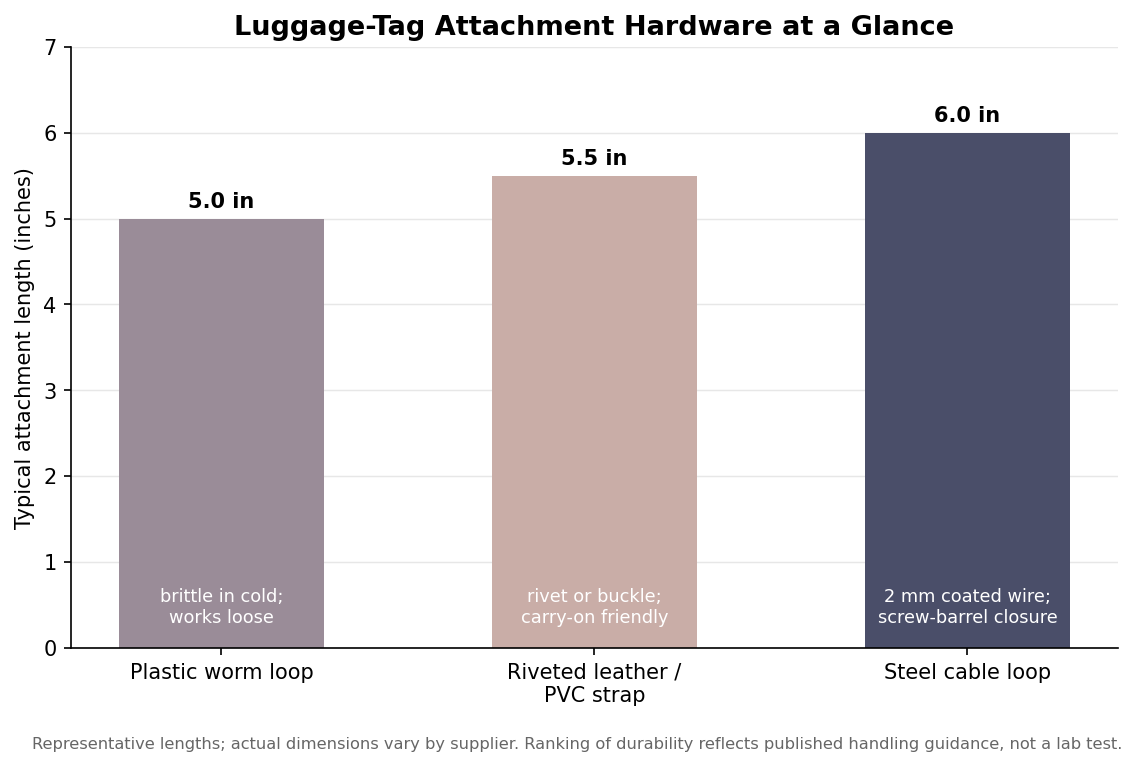
Match the fastener to the life you expect the tag to have. A resort that hands tags to guests who will check bags for years should not be shipping worm loops; a wedding favor that travels home once can. The lengths above are representative and vary by supplier, and the durability order reflects published handling guidance rather than a controlled lab test, but the ranking holds up on any baggage belt.
Where you attach it matters as much as what
Even the best loop fails if it is put in the wrong place. The single most common installation mistake is clipping the tag to a zipper pull or a thin side handle instead of the main top carry handle. Zipper pulls flex and can tear off; side loops snag. The top handle is the anchor point built to take load, and a tag secured there and pulled tight is dramatically more likely to arrive with the bag. This also affects how you punch the tag: a round hole suits a wire cable loop, while a wider slot is what a flat strap needs to pass through, and a tag punched for one will not take the other cleanly. Deciding the fastener before the die is punched saves a mismatch that quietly weakens every unit.
How to spec a tag that stays on
Turn this into three lines on your next order. First, choose the fastener on purpose rather than accepting the default, and for anything that will fly checked, specify a steel cable loop or a riveted strap instead of a worm loop. Second, make sure the hole or slot is punched to match that fastener, so the hardware seats the way it should. Third, if your tags carry a brand and go to travelers, add a one-line care note or insert telling recipients to fasten the tag to the top handle and pull it tight, because the finest hardware still loses to a loose knot. Get those three right and the tag does the job you bought it for, which is to stay on the bag and keep your name on it for the length of the trip.
Leave a Reply